Maintenance
Part of Festival, subculture, and community arts reporting guide
Festival fact-check checklist for arts coverage
A festival fact-check checklist for verifying event identity, program credits, attendance methods, access, consent, images, and corrections in arts coverage.
What to take away
- Fix the event date, location, program version, observation window, and organizer before checking interpretation.
- Verify credits by role and distinguish scheduled, substituted, canceled, and observed appearances.
- Attach a method and time span to every attendance, revenue, survey, or economic-impact figure.
- Check physical, communication, sensory, digital, and price access separately.
- Carry corrections through captions, schedules, artist pages, newsletters, and licensed copies.
Use this festival fact-check checklist after the event and again after layout. Mark every line verified, qualified, not applicable, or unresolved.
Event identity and observation
- Event date and location confirmed against a dated source
- Organizer identified and credited; organizer-supplied details distinguished from independent checks
- Program version recorded, including when and where it was obtained
- Observation window recorded, including sessions or activities attended and not attended
Event identity and observation
- Official and community names checked
- Organizer, producer, host, venue, sponsor distinguished
- Date, hours, site boundary, weather recorded
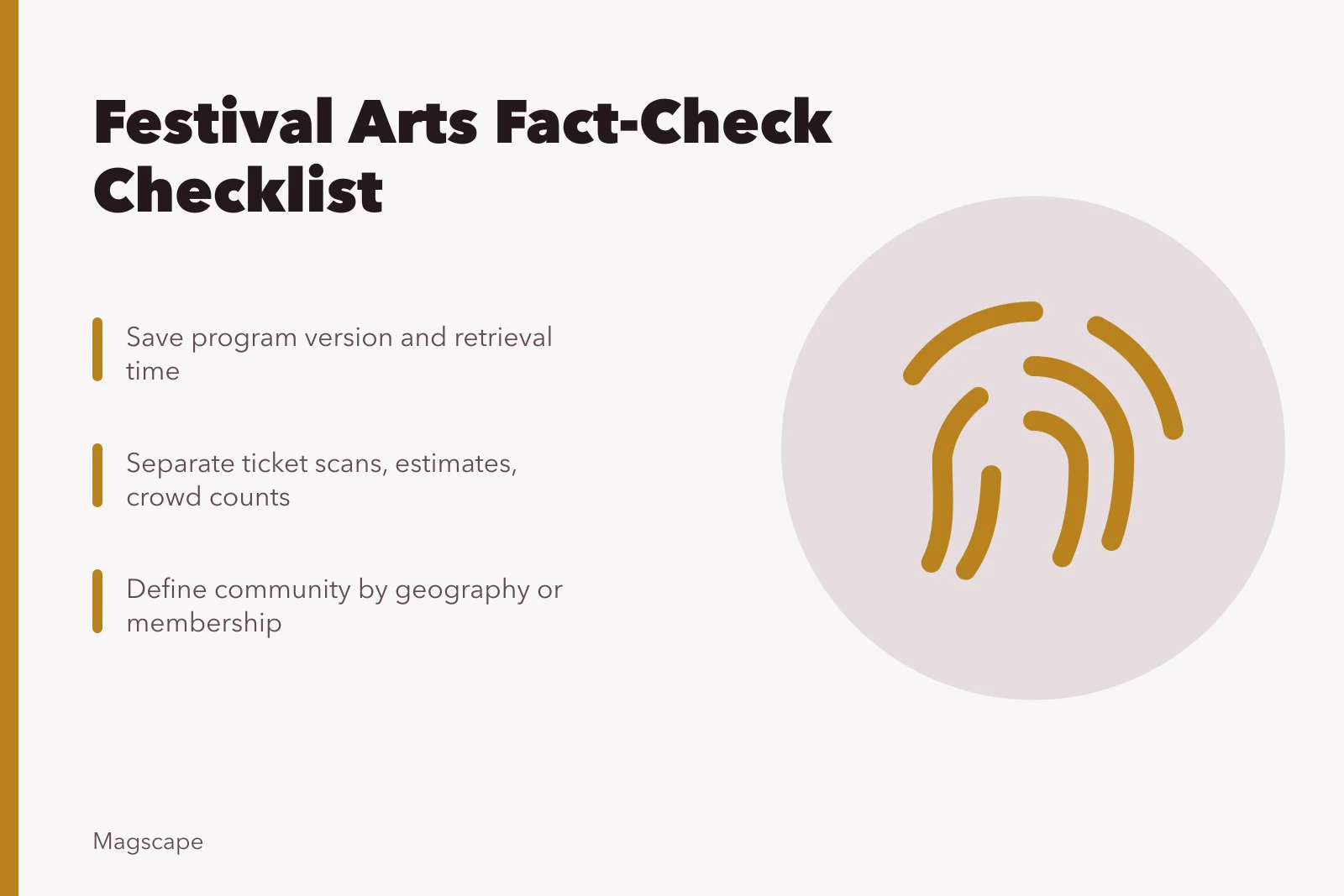
- Program version and retrieval time saved
- Reporter arrival, departure, route, missed stages stated
- Preview, rehearsal, public program, after-event separated
Program and credits
- Artist, ensemble, venue, and partner names checked against reliable sources
- Credits verified by role, such as performer, curator, producer, or commissioner
- Scheduled, substituted, canceled, observed, and not-observed appearances distinguished
- Program changes checked against dated schedules, on-site notices, or direct confirmation
- Sponsor, funder, and commissioning credits checked against the program or direct confirmation
Program and credits verification
- Artist, group, work, tradition, language names confirmed
- Pronouns and public identification checked
- Lead, collaborator, apprentice, host, translator roles separated
- Substitutions, delays, cancellations, set changes verified
- Traditional, adapted, commissioned, new work distinguished
- Credit list checked with participants, not only promotional copy
Attendance, surveys, and money
- Ticket scans, entries, estimates, capacity, and momentary crowd counts not blended
- Attendance source, method, date range, and repeat-entry policy stated
- Survey sample, location, timing, question, and response count disclosed
- Budget, grant, sponsorship, fee, sales, and artist payment terms dated
- Reported amounts include their source, date, currency, unit, and gross or net basis; estimates are labeled
- Gross spending distinguished from profit or local economic effect
The National Endowment for the Arts (NEA) outdoor festival case studies describe short attendee surveys at seven festivals and explicitly warn that their aggregate was exploratory, not a national sample. That distinction should remain visible whenever an event survey is used to characterize a larger public.
Community and cultural claims
- "Community" defined by geography, membership, practice, or recruitment method
- Self-described names used and outside labels attributed
- Claims of origin, first use, survival, revival, and authenticity checked
- Sacred, private, restricted, or commercially sensitive knowledge excluded as required
- One speaker not made representative without evidence
- Meaningful disagreement reported with context
Consent and identification
- Intended publication and image use explained
- Minor and guardian procedures followed
- Legal name, scene name, anonymity, and location risk assessed
- Close photographs and sensitive activities have appropriate permission
- Withdrawal or restriction requests handled under the agreed terms
- Applicable state recording, privacy, and publicity rules identified; do not assume one release form applies everywhere
- If a covered online service collects personal information from children under 13, check the Children's Online Privacy Protection Act (COPPA) and the FTC's Children's Online Privacy Protection Rule; these are not general event-photo consent rules
Access and public conditions
- Transport, parking, route, surface, entrances, exits, and rest areas checked
- Seating, shade, water, restrooms, counters, and viewing areas noted
- Captioning, interpretation, assistive listening, audio description, and language access verified
- Website, ticketing, maps, schedules, and emergency information checked
- Free, suggested donation, partial charge, and full admission described accurately
- Access information dated and tied to the tested site or session
- Applicable Americans with Disabilities Act (ADA) access requirements considered for the venue
- Web Content Accessibility Guidelines (WCAG) used as a reference when checking websites and ticketing
- Section 508 checked where relevant to federal agency information and communication technology; it is not a universal requirement for every festival
The NEA's brief accessibility checklist covers designated responsibility, advisory participation, sign-language interpretation, scripts, assistive listening, captions, audio description, alternate formats, high-contrast labels, accessible websites, tactile tours, and access information in publicity. Use it to generate checks, then report the features directly confirmed.
Images, rights, and final copy
- Photographer, date, location, depicted person, and activity checked
- Organizer-supplied and editorial images labeled internally
- Crop, composite, filter, or staging disclosed when material
- Artwork image rights and participant permissions documented
- Rights, license, or applicable exception checked under the Copyright Act of 1976 (Title 17 of the U.S. Code)
- Quotation checked against recording and speaker identity
- Headline, metadata, captions, embeds, and social copy rechecked
Common questions
Can an organizer estimate be published?
Yes, as an attributed estimate with its method and covered period.
Must every attendee in a wide crowd image consent?
Rules and context vary. Avoid exposing sensitive participation and seek advice when risk or restrictions are present.
Is "sold out" the same as full attendance?
No. It refers to ticket availability, not necessarily entries or occupied capacity.
What should delay publication?
Delay when identity, consent, cultural restriction, credit, or a central allegation cannot be handled responsibly through qualification.