Guides
Part of Heritage, archives, and public history reporting guide
The archival research method, step by step
Archival research method for framing claims, searching hierarchies, requesting material, logging citations, reading context, resolving conflicts, and stating limits.
What to take away
- Start with a bounded claim and a list of names, dates, places, agencies, spellings, and record types.
- Search from collection or record group down to series, box, folder, and item.
- Capture the full citation and surrounding context before extracting a quotation.
- Track negative searches and conflicting evidence instead of quietly discarding them.
- State access limits, missing years, uncertain identities, and unverified inferences in the draft.
Archival research is not a hunt for one perfect document. It is a controlled process for locating records, understanding why they exist, comparing them, and showing where the evidence stops.
Photo and credit
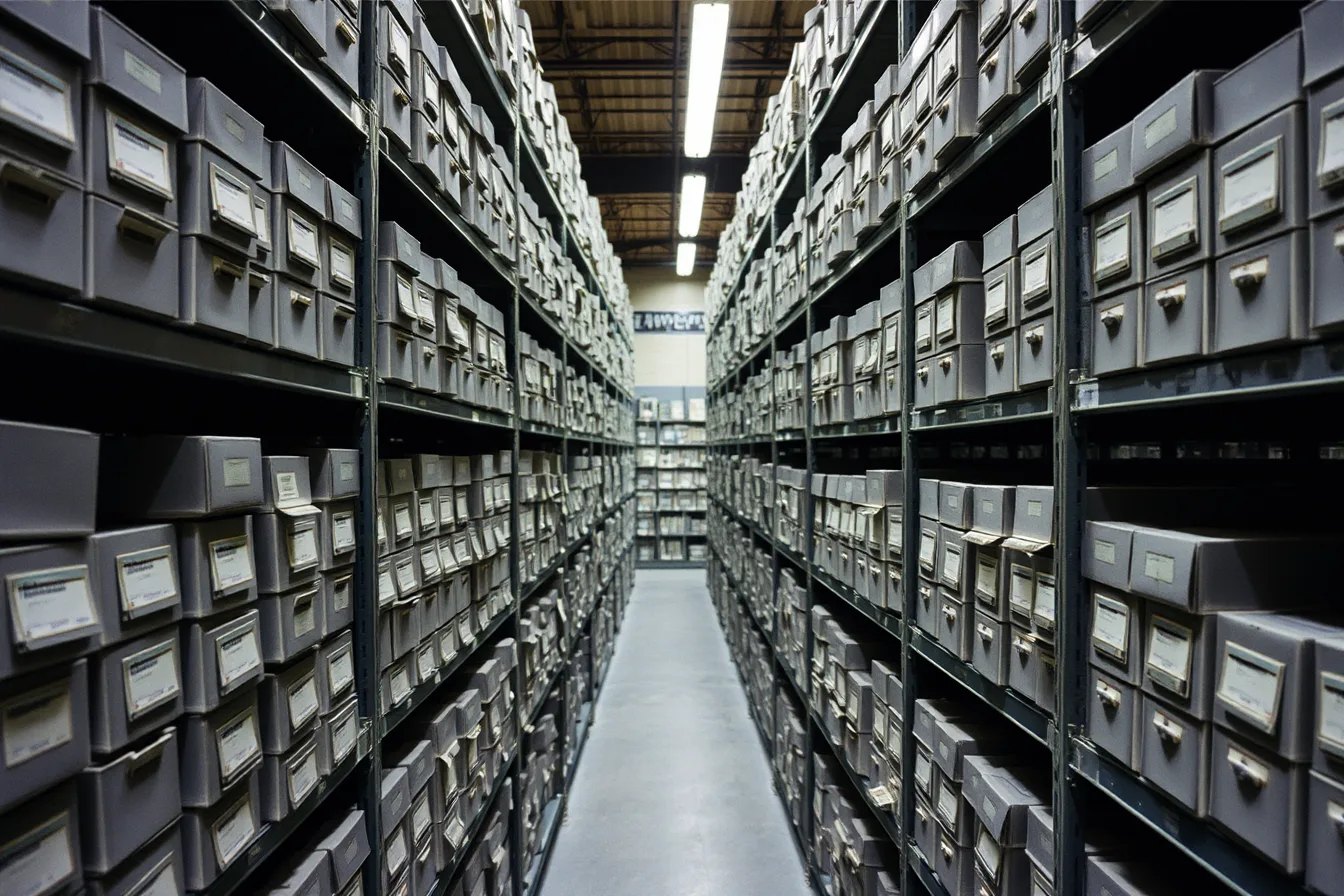
The photograph depicts storage boxes and shelving. Labels are not used here to identify or describe any particular collection.
Step 1: convert the topic into claims
Break the assignment into facts that could be true, false, disputed, or unresolved. A story about a civic hall might require its commission date, architect, construction period, opening date, first use, later wing, ownership, and current interpretation.
Create a search sheet with variant names, former addresses, jurisdictions, agencies, businesses, personal relationships, date ranges, and likely record types. Add the language used in the period, including older institutional names.
Step 2: identify repositories and creators
Record type to repository
Record type
- City permits
- Municipal archive
- Federal correspondence
- National repository
- Business files
- University collection
- Community photographs
- Private hands
Likely repository
- City permits
- Federal correspondence
- Business files
- Community photographs
Do not assume digitized search results represent the holdings. Read repository guides, collection descriptions, finding aids, access rules, rights notes, closure periods, and reading-room procedures.
Step 3: search the hierarchy
Search broadly for the creator, then narrow by record group or collection, series, file unit, and item. The National Archives catalog search tips describe exact-phrase searches and filters for level of description, location, title, geography, record group, collection identifier, and creator. These fields help distinguish an item from the larger body of records that gives it context.
Search the hierarchy
- Search broadly for the creator
- Narrow by record group or collection
- Narrow by series
- Narrow by file unit
- Narrow by item
Save the description page even when no digital object appears. It may identify the repository, series, scope, dates, and creator needed for a request.
Step 4: prepare the request
Send precise references: collection or record group, series, box, folder, item, identifier, and date range. Ask about unprocessed additions, related collections, restrictions, copying rules, fees, appointments, and permitted equipment.
Prioritize requests before the visit. Begin with finding aids and broad files that can redirect the search. Leave time for adjacent folders because filing labels do not always describe every enclosed item.
Step 5: create a research log
For every item, record:
- repository and collection hierarchy
- creator, title or supplied description, date, and identifier
- box, folder, page, image, or time code
- physical or digital format
- rights and reproduction note
- file name for any permitted copy
- transcription and your separate interpretation
Photograph the folder label and citation slip before the item when rules allow. Keep files in encounter order until they are safely renamed and backed up.
Step 6: read around the item
Examine preceding and following pages, attachments, envelopes, stamps, routing marks, handwriting changes, and later annotations. Ask who created the record, for what task, under what rules, and for which audience.
A meeting minute may summarize rather than transcribe. A newspaper opening notice may repeat publicity. A photograph may have a later caption. A catalog date may describe creation, publication, acquisition, or digitization.
Step 7: compare and classify
Build a claim table:
| Claim | Supporting record | Contrary record | Status |
|---|---|---|---|
| Hall opened May 3 | dated program | newspaper says May 10 | unresolved |
Classify support as direct, indirect, negative, reported, or inferred. Resolve apparent conflict by asking whether the records describe different events or versions.
Step 8: write with limits
Use exact citations in notes, readable attribution in prose. The UK National Archives' guide to citing records treats repository name plus full catalogue reference as a citation's core, precise enough for another researcher to locate and verify the document.
Say "a May 3 dedication program," not an opening date, if the event type remains uncertain. Describe collections and years searched when an absence matters.
Common questions
Should I begin with item-level keyword searches?
Use them for discovery, then move upward to the collection and series before interpreting the item.
Can I rely on a catalog description?
It can establish descriptive metadata, but read the item when making claims about its contents.
What is a negative search?
It is a documented search that found no relevant record in a stated place and range. It is not proof that no record exists anywhere.
How should file names be organized?
Use stable identifiers, dates, repository codes, and sequence numbers without changing the original citation.