Rules
Part of Theater, dance, and performance reporting guide
Common performance coverage problems and fixes
Performance coverage fixes for wrong casts, director-only credit, vague movement, one-night overclaims, access shortcuts, rehearsal confusion, and archive certainty.
What to take away
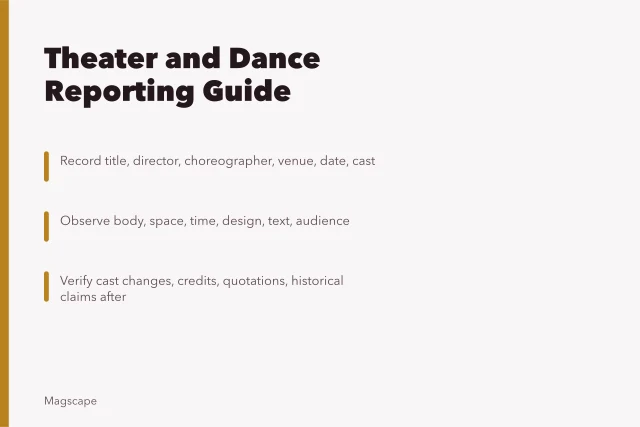
- Confirm the cast actually seen, including understudies, swings and replacements, before filing.
- Credit collaborators by the work they did, not by the director's name alone.
- Describe movement in verbs, weight and direction so the reader can picture it.
- Bound every audience claim to a date, a seat and a moment.
- Mark archive reconstruction as inference and name the item consulted.
A review is a record as well as a judgment. When the record is wrong, the judgment cannot be checked, and the correction lands weeks later on a page nobody revisits.
Problem: the review names the usual cast
Symptom: The critic works from the website or the main program and misses an understudy, a swing, a replacement, or a mid-performance substitution.
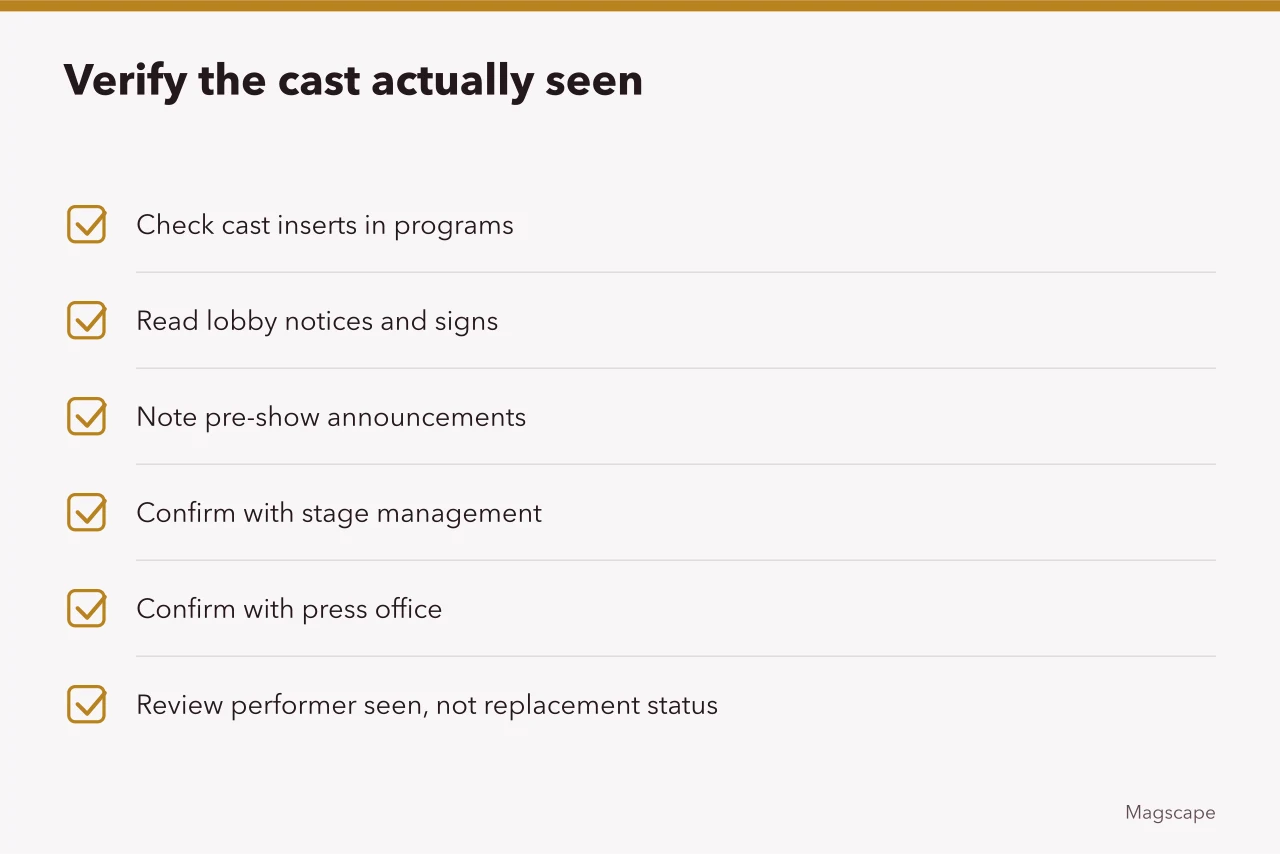
Understudy identification is the most common error in this category, and the easiest to prevent. Check the cast insert, the lobby notice, the pre-show announcement, and stage management or press confirmation.
Then review the performer who was actually on, without treating replacement status as a deficit. A swing covering three tracks in one week is a fact about the production, not a mark against it.
Problem: the director did everything
Here is the lead-in and list:
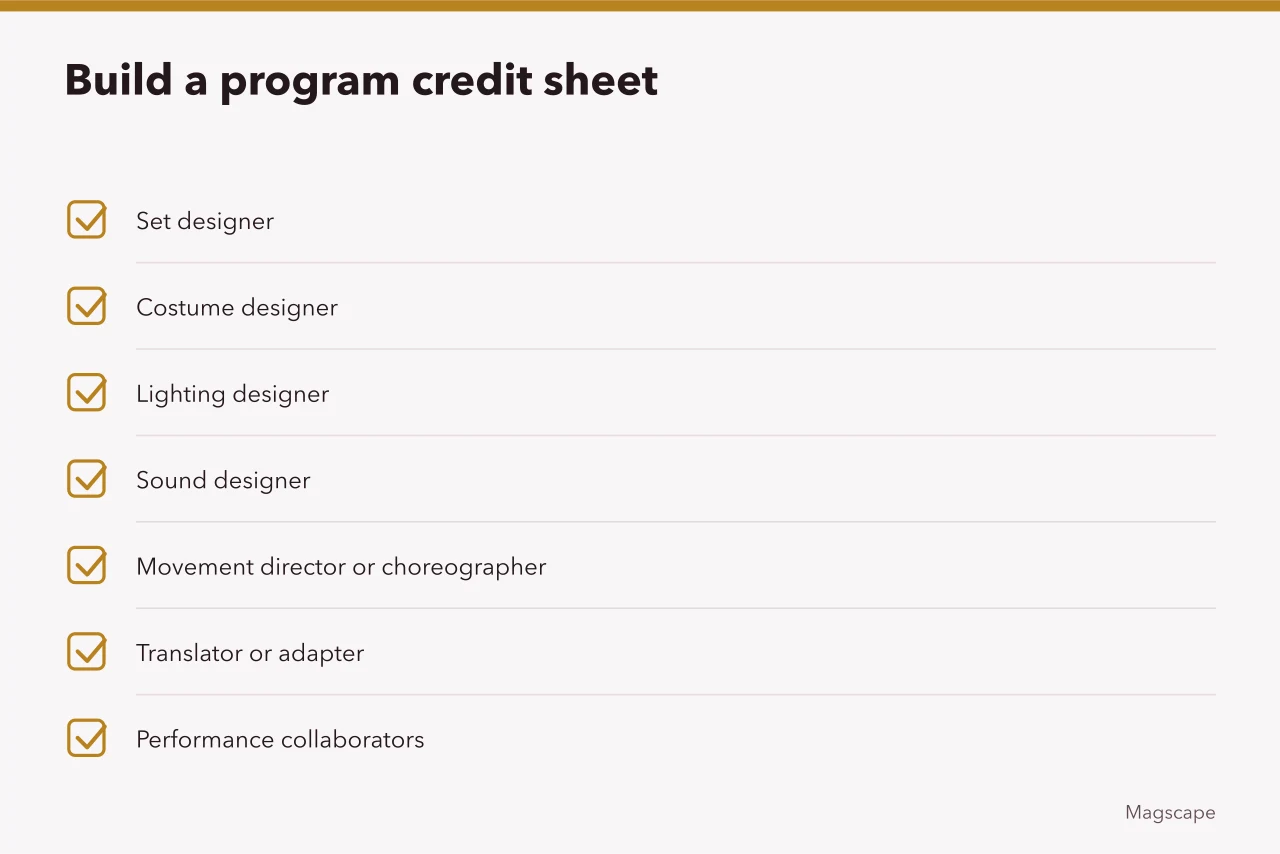
Fix: Build a credit sheet from the program before drafting, then name the relevant collaborators in the paragraph where their work is discussed. When the process is unclear, describe the effect on stage and leave authorship open. Guessing at authorship is a factual error, not a stylistic one.
Problem: movement becomes emotion words
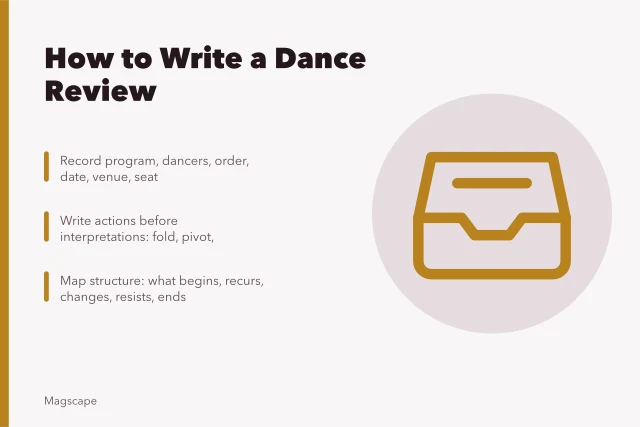
Symptom: Dancers are powerful, fluid, angry or graceful, and the reader still cannot picture a single action.
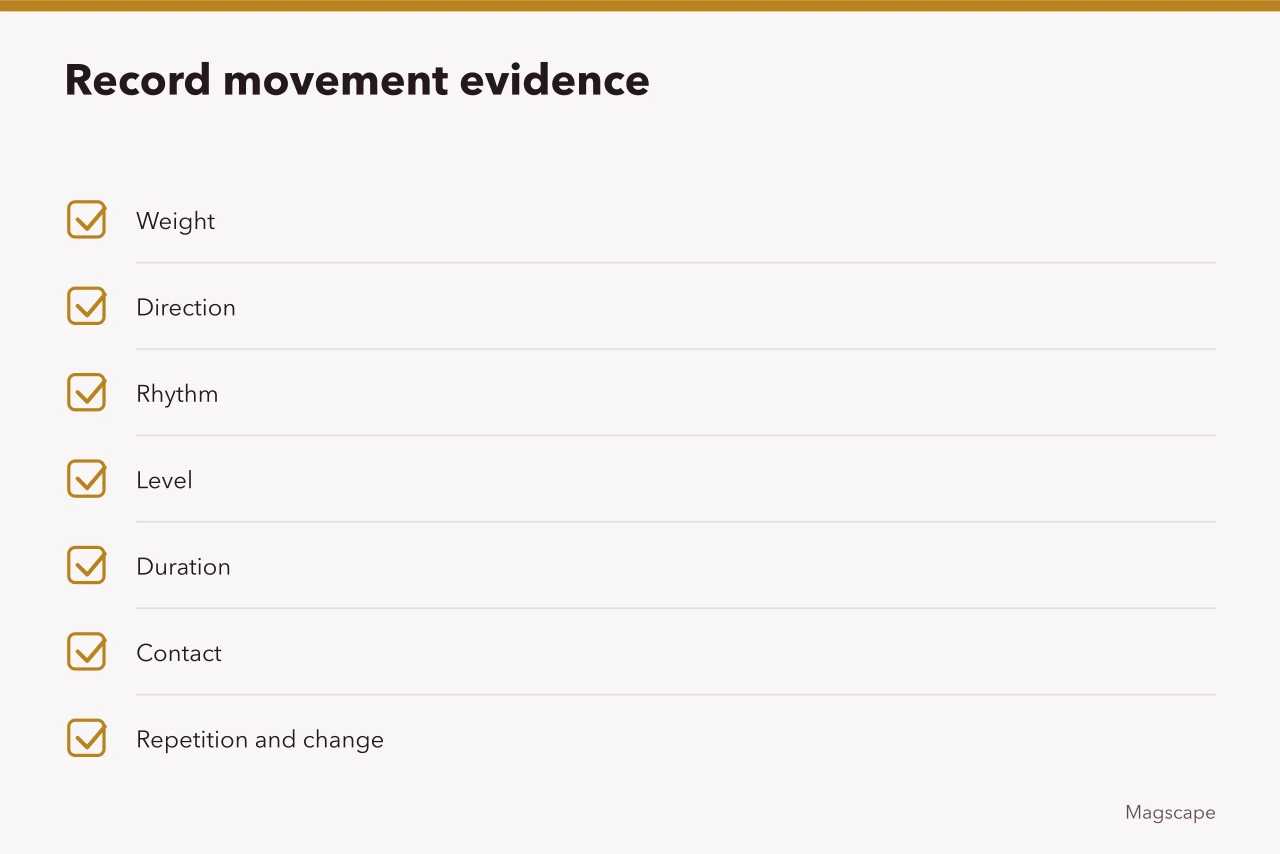
Fix: Use verbs and relations. Record weight, direction, rhythm, and level. Then record duration, contact, repetition, and change. Then give the emotional or formal reading as interpretation, clearly separated from the description.
Problem: one night defines the run
Symptom: A missed cue, a cough, a technical pause or a laugh becomes a claim about every performance in the run.
Fix: Name the date and the observed event. Ask whether the condition was planned, local to that performance, or repeated. Audience response bounding belongs here: a laugh at one moment in one seat is a laugh at one moment in one seat.
Problem: a rehearsal becomes a review
Symptom: Press access to unfinished work is packaged as judgment on the public production.
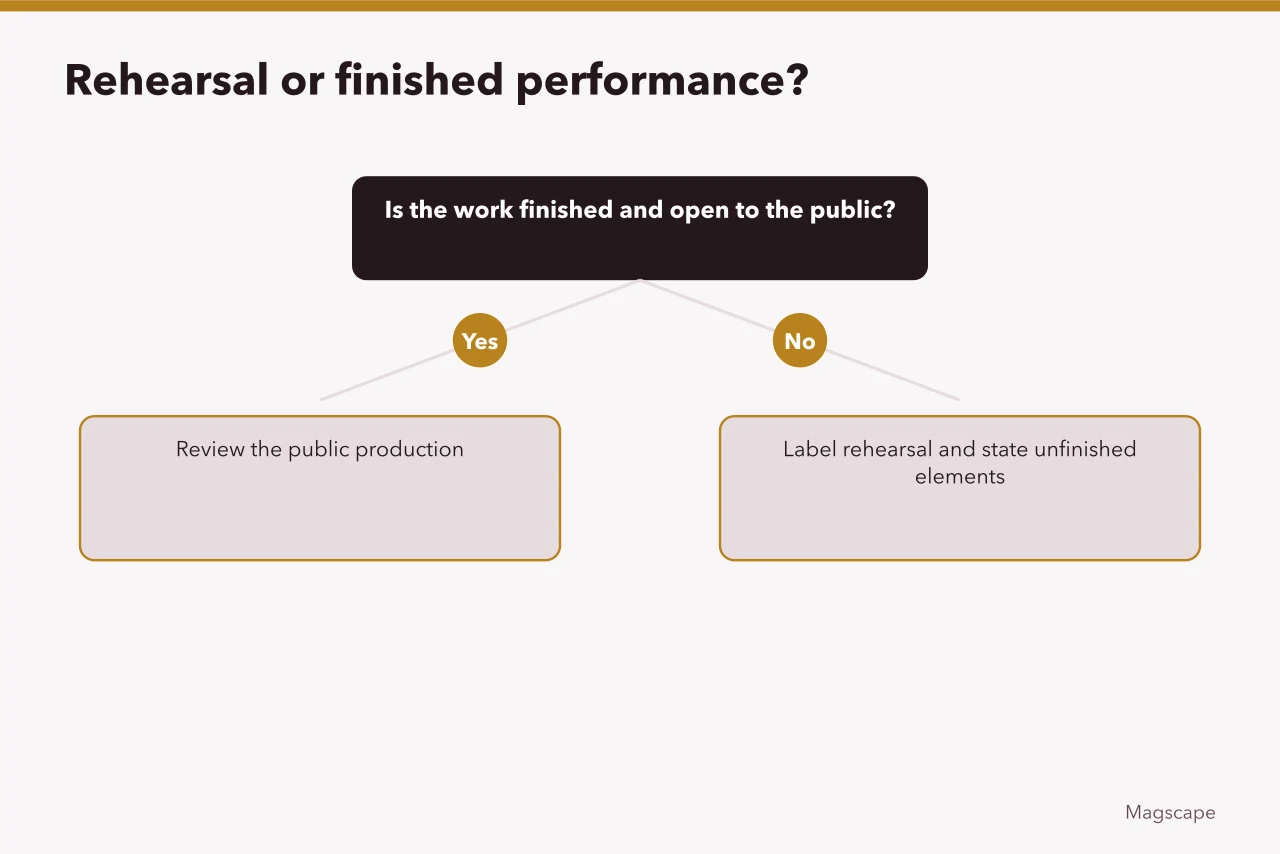
Fix: Label the rehearsal and state the unfinished elements. Rehearsal labeling means the piece says what it saw, at what stage, and under what conditions. Change the form to a preview or a process report, or attend a completed performance.
Problem: access is reduced to wheelchair entry
Symptom: The article declares a venue accessible after finding a ramp or an elevator.
Fix: Check routes, seating, sight lines, and restrooms. Check booking, captions, interpretation, and hearing systems. Check audio description, touch tours, program formats, and staff procedures. Check performance-specific schedules. Report what you checked and on which date.
The National Endowment for the Arts co-published Design for Accessibility, a cultural administrator's handbook. The handbook covers planning, legal duties, architectural access, and usability. It addresses making facilities, meetings, websites and print materials usable by everyone.
The range shows why one physical feature cannot support a venue-wide claim. Licensing and access requirements vary by jurisdiction; the venue's own published access statement and the relevant licensing authority are the sources to cite.
Problem: participation is treated as consent to coverage
Symptom: A critic identifies audience members, photographs them, or describes sensitive participation without weighing consent.
Fix: Follow the event's rules, seek consent for identifiable reporting, and weigh public interest against harm. Taking part in a performance does not erase privacy on its own.
Problem: archival fragments become a complete performance
Symptom: A photograph, program, promptbook or review is used to claim exactly how a vanished event looked and felt.
Fix: Identify source type, creator, date, purpose, vantage point and gaps. Combine independent evidence and mark reconstruction as inference. A program records announced credits and plans; it does not capture execution.
Build a source matrix before writing the historical scene. A promptbook may preserve cues and handwritten changes. A production photograph preserves one selected instant from one angle. A review records another writer's response under its own deadline and standards. Correspondence can explain intent or conflict while staying partial and self-interested.
Check whether the materials belong to the same venue, date, cast, tour stop and production version. Later revivals often reuse titles, designs or publicity images. If evidence conflicts, present the disagreement and say why the record cannot settle it. Specific gaps make a reconstruction more credible than invented detail that fills every one.
The Library of Congress performing-arts research-guide index routes researchers to dance, theater, music, collections and subject guides.
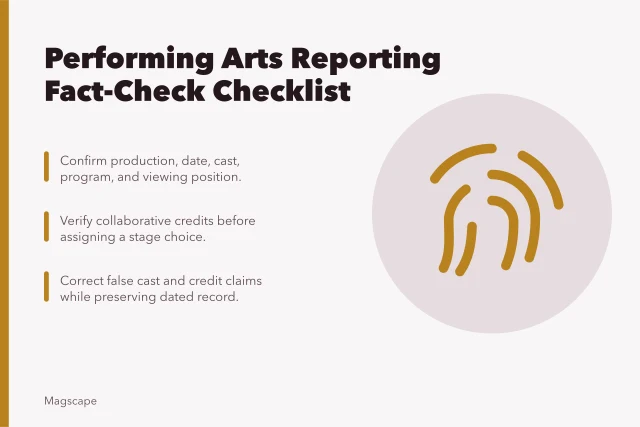
Use the guide that matches the claim and record the item consulted rather than citing a collection in the abstract. Working through that evidence is where a performing arts reporting fact-check checklist earns its keep, because each source type carries its own failure mode.
Problem: audience response settles quality
Symptom: Applause, laughter, walkouts or a standing ovation is treated as a vote that ends criticism.
Fix: Describe the response by location and moment. Consider house customs, invitations, participation rules and limited sight lines. A critic can note reception without outsourcing judgment to it.
Problem: identity replaces craft
Symptom: A performer's body, age, disability, gender, race or nationality becomes the whole description.
Fix: Name identity when it is relevant and supported, then analyze artistic agency, movement, voice, relation and production frame. Do not guess private identity or medical information from appearance.
Repair table
| Weak claim | Missing evidence | Repair |
|---|---|---|
| "The lead was flat" | Performer and conditions | Name the cast and describe timing, voice or relation |
| "Beautiful choreography" | Movement evidence | Describe pattern, weight, space and change |
| "The venue is accessible" | Scope and features | Name route, service, performance and date |
| "The audience hated it" | Valid reception evidence | Bound the observed response |
| "The archive proves" | Source limits | Identify items and mark inference |
Common questions
Can a critic mention an error on stage?
Yes, when it was observable and relevant to the production. Do not call it an error without evidence that it was unintended. If the point matters to the review, ask stage management or press before publication.
Should an understudy be identified in the headline?
Only when the substitution is editorially material to the piece. The body and the metadata must still credit the performer accurately, whichever name appears above the fold.
Can a relaxed performance be compared with another night?
Yes, if both conditions are identified and the comparison respects the adjustments the production has stated. Say which performance you attended and what was changed for it.
Is a standing ovation meaningful evidence?
It documents a visible response under specific conditions, including invitations to stand and house custom. It does not establish unanimous opinion or artistic value.