Rules
How Do Museum Deaccession Rules Differ by US State?
Museum deaccession rules state by state decide who may sell, what the money can buy, and who reviews the decision. New York and California are the strictest.
What to take away
- Every US state with charitable-solicitation authority can review a museum sale, but only a few set hard rules on what the money may buy.
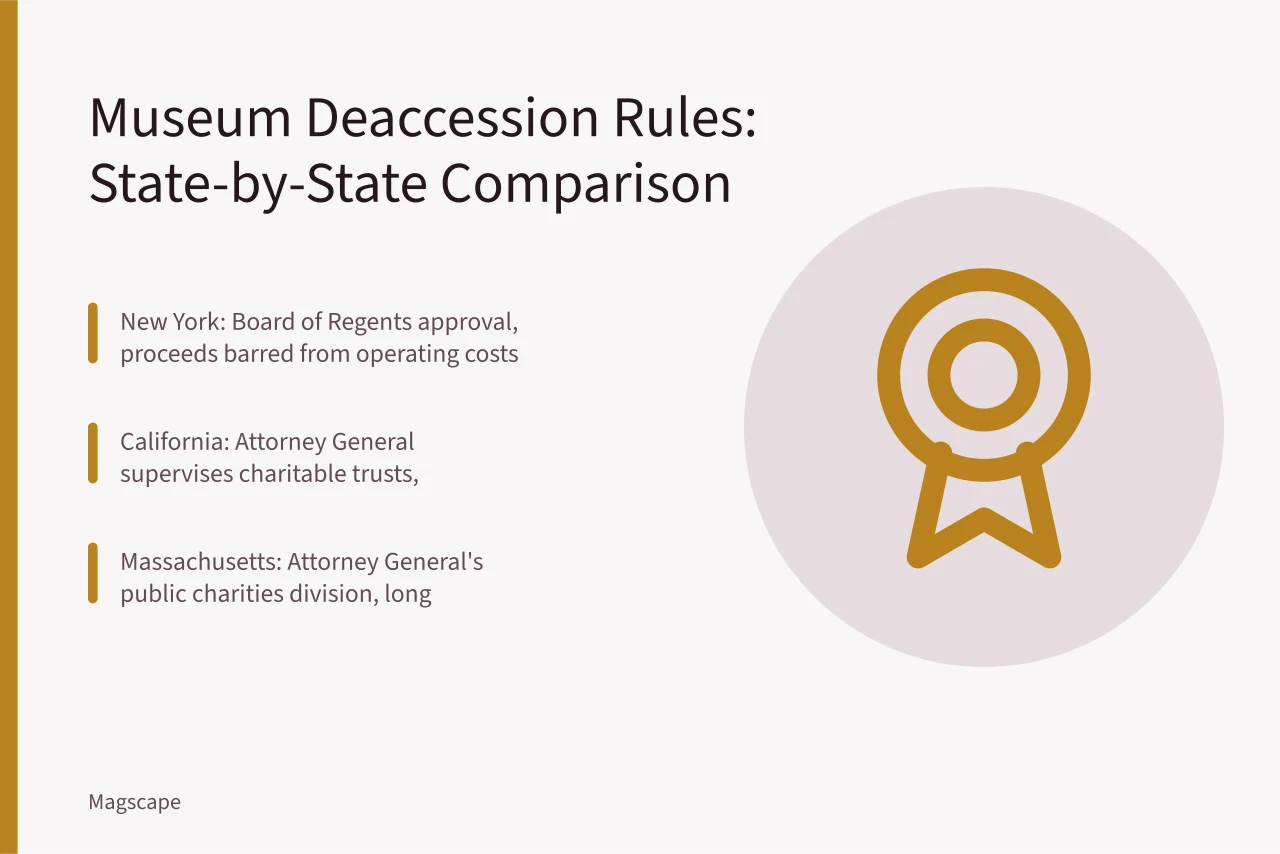
- New York and California impose the tightest constraints, through the Board of Regents and the Attorney General's charitable trust supervision respectively.
- Most states leave deaccessioning to institutional policy, professional standards from the American Alliance of Museums, and the terms of the original gift.
- A reviewer reading a controversial sale should check the state's oversight body, the museum's charter, and the donor's gift instrument before judging the ethics.
- No state statute forces a museum to spend sale proceeds on new acquisitions, which is why the sharpest fights are about intent rather than legality.
The rulebooks being compared
Deaccessioning is the formal removal of an object from a museum's permanent collection. The sale of that object is a separate act, and it is the sale that draws coverage. Three rulebooks govern it: state charity law, the museum's own collections policy, and the gift agreement signed by the donor.
New York, California, Massachusetts and a handful of others write parts of the first rulebook into regulation. The rest rely on the second and third. That split is the whole comparison.
The criteria that matter
Four criteria separate the states in practice. Whether a state official must approve a sale. Whether proceeds are restricted to acquisitions or care. Whether public notice is required. Whether the attorney general can sue to reverse a sale.
| Criterion | New York | California | Massachusetts | Most other states |
|---|---|---|---|---|
| Approval body | Board of Regents, via Education Law | Attorney General, charitable trusts | Attorney General, public charities division | None specific |
| Proceeds restriction | Acquisitions or direct care, by policy and Regents rules | Acquisitions or direct care, enforced as trust terms | Acquisitions or direct care, by practice | Institutional policy only |
| Public notice | Required for chartered museums in some cases | Not statutory, but AG review can force disclosure | Filing with the AG's office | Rare |
| Enforcement | Regents can revoke charter | AG can seek injunctive relief | AG can sue trustees | Consumer protection statutes |
New York and California, option by option
New York is the strictest because its museums are chartered by the Board of Regents. That charter is a state-granted privilege, and the Regents have used it. The 2020 rules adopted after the Brooklyn Museum and Baltimore Museum controversies bar proceeds from being used for operating costs, a position the state's cultural institutions have had to absorb.
California works through the Attorney General's supervision of charitable trusts. A museum holding restricted gifts is a trustee, and the AG can argue that a sale converts restricted assets to unrestricted cash. The office has used that power in settlement agreements rather than litigation, which keeps the case law thin but the pressure real.
Massachusetts is the quiet third. The Attorney General oversees public charities, and the office reviews museum governance and sale questions. A reviewer covering a Boston sale should expect the AG's office to be a named party in any dispute.
Where each approach wins
New York wins on clarity. A reporter can point to a specific rule and a specific regulator, which makes the story easier to write and harder for a museum to deflect.
California wins on flexibility. The Attorney General's trust theory adapts to unusual gifts, including fractional interests and promised bequests, in a way a fixed regulation cannot.
Massachusetts wins on precedent. The state has a long record of charity enforcement, so trustees know the office's expectations before a sale is announced.
Most other states win on speed. A museum in a state with no specific oversight can complete a sale in months, which is exactly why some institutions relocate collections across state lines before selling.
The shared limitation
No state rule settles the ethics question a critic is actually asked about. A sale can be lawful in every jurisdiction and still breach the donor's intent, and a sale can be barred by a gift agreement that no state regulator would ever read.
That gap is why the American Alliance of Museums' code and the Association of Art Museum Directors' guidelines carry weight. They are voluntary, and a museum can resign rather than comply. The Wikipedia article on deaccessioning lays out the major controversies without resolving the underlying tension.
Provenance is the other blind spot. A sale price tells you nothing about whether the object was lawfully acquired, and the Getty Research Institute provenance tools are the standard starting point for checking ownership history before a sale is reported.
A state rule can stop a sale. It cannot tell you whether the sale was right.
How a reviewer should read a sale
- Identify the state and the regulator with jurisdiction, then check whether the museum is chartered, incorporated, or both.
- Pull the museum's collections policy and any gift agreement referenced in the announcement.
- Compare the stated use of proceeds against the state restriction and the donor's terms.
- Ask whether the sale was noticed publicly and whether the regulator commented.
- Check provenance separately from price, because the two questions rarely overlap.
- Confirm the state regulator and its statutory authority
- Read the museum's collections policy, not just the press release
- Check the gift instrument for a restriction on sale
- Verify the announced use of proceeds against the rule
- Trace provenance independently of the sale price
Example. A museum in a state with no deaccession statute sells a painting to fund roof repairs. Nothing in state law forbids it. If the painting was a restricted gift, the Attorney General in California or Massachusetts could still object, and a New York chartered museum could face Regents review. The same sale is legal in one state and contested in another, which is the point of comparing the rules at all.
Common questions
Do all states regulate museum deaccessioning? No. Only a minority set specific rules. The rest rely on general charitable trust law and institutional policy, which is why outcomes vary so widely.
Can a museum spend sale proceeds on operating costs? In New York and California, generally no, unless a regulator approves. In most other states it depends on the museum's own policy and the donor's terms.
What is the strongest legal check on a sale? A restricted gift agreement. It binds the museum regardless of state law, and it is the document most often ignored in coverage.
Where should a reporter start? With the state attorney general's charitable division and the museum's charter. The Massachusetts Attorney General's office publishes its charity oversight material and is a useful model for reading other states.