Maintenance
Part of Theater, dance, and performance reporting guide
Performing arts reporting fact-check checklist
Performing arts checklist for productions, dates, casts, credits, movement, text, design, access, archives, rights, conflicts, quotations, and corrections.
What to take away
- Check the exact production, performance date, cast, program, and viewing position.
- Verify collaborative credits before assigning a stage choice.
- Separate observation, program language, interview claims, and interpretation.
- Describe access features by performance and venue rather than using one broad label.
- Correct false cast and credit claims while preserving the dated event record.
Use this checklist before publishing a theater review, dance criticism, preview, profile, production report, or archive feature. Mark items not applicable where necessary and retain evidence for every consequential correction.
Event record
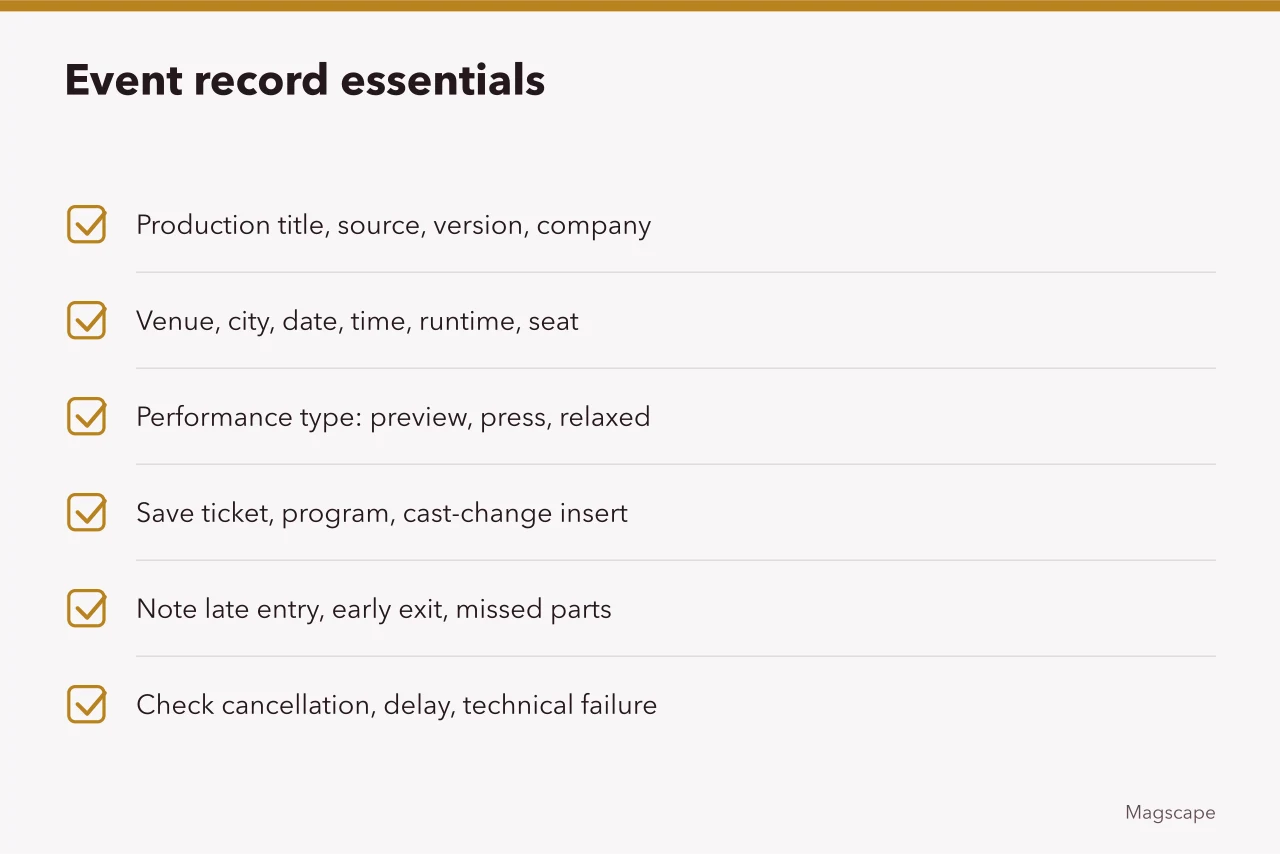
- Confirm production title, source work, version, adaptation, translation, and producing company.
- Record venue, city, performance date, start time, runtime, interval, and reviewer's seat or route.
- Identify preview, opening, press, regular, relaxed, school, gala, or recorded performance accurately.
- Save the ticket, program, cast-change insert, lobby notice, and announcement notes.
- State whether the writer entered late, left early, moved, or missed part of a durational work.
- Check cancellation, delay, interruption, or technical failure with a responsible source.
People and credits
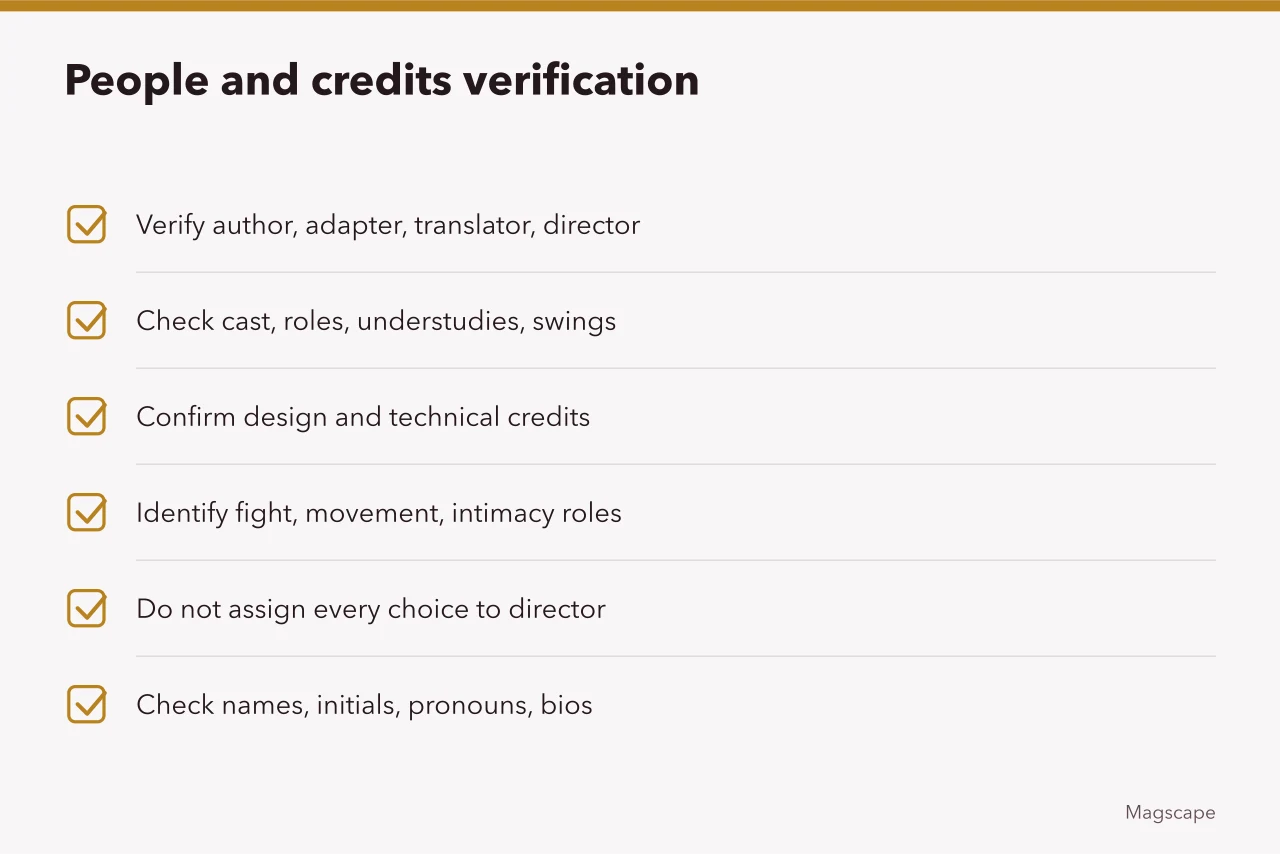
- Verify author, adapter, translator, director, choreographer, dramaturg, and composer.
- Check cast, roles, understudies, swings, replacements, musicians, and speakers for that performance.
- Confirm scenic, costume, lighting, sound, projection, video, makeup, hair, puppet, and effects credits used in copy.
- Identify fight, movement, intimacy, dialect, music, rehearsal, and stage-management roles when relevant.
- Do not assign every choice to the director.
- Check names, initials, pronouns, company positions, and biographies.
What happened on stage
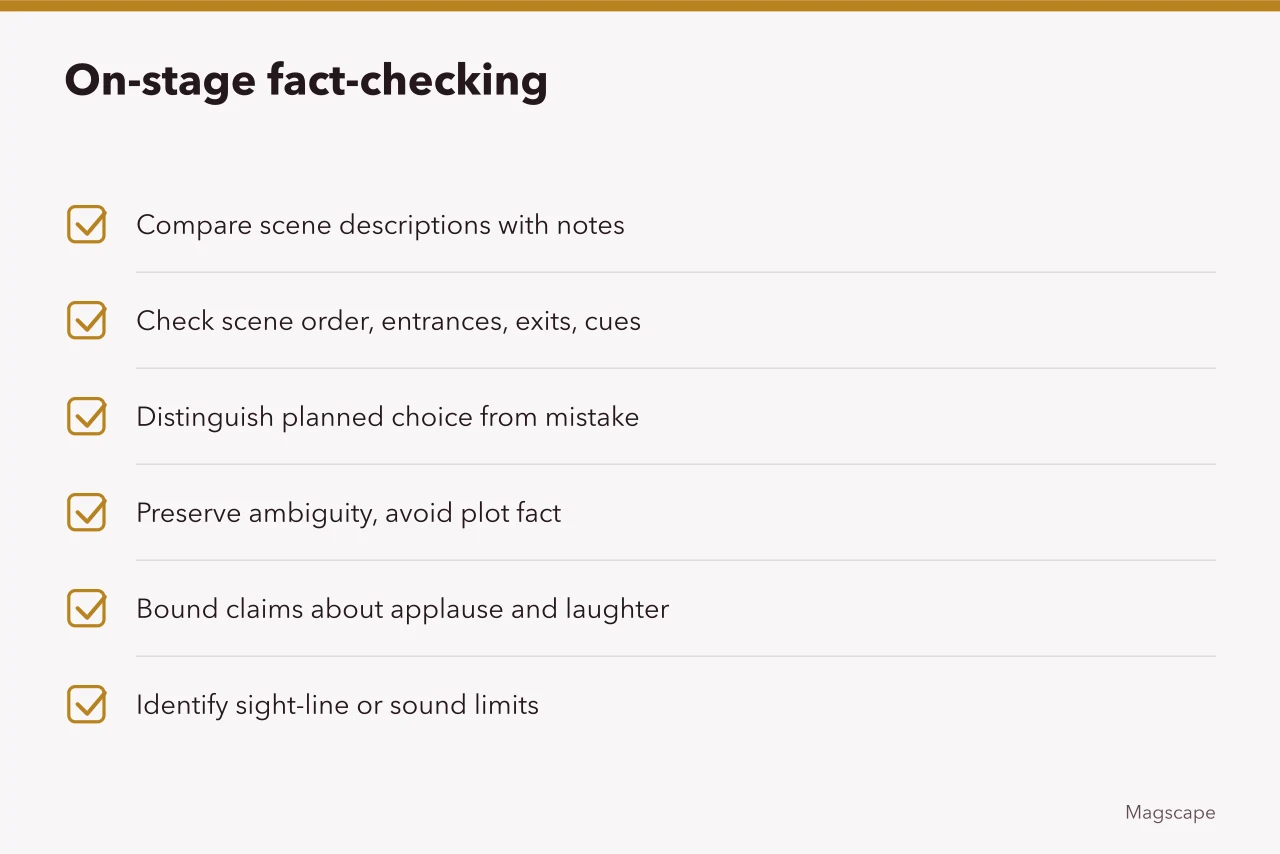
- Compare every detailed scene or movement description with contemporaneous notes.
- Check scene order, character knowledge, entrances, exits, objects, cues, and ending.
- Distinguish a planned choice from a mistake only when evidence supports the distinction.
- Preserve ambiguity and do not convert interpretation into plot fact.
- Bound claims about applause, silence, laughter, participation, exits, and audience consensus.
- Identify sight-line or sound limits connected to the reviewer's location.
Text, movement, and rights language
- Check quoted dialogue against the performed or published version where available.
- Identify cuts, additions, improvisation, devised material, and translated text carefully.
- Distinguish the play, choreographic work, production, and individual performance.
- Avoid calling every movement sequence choreography without checking credits and process.
The U.S. Copyright Office's Circular 52 on choreography and pantomime says choreographic works are a subset of dance, not a synonym for all movement. Individual steps, social dances, simple routines, and ordinary motor activity each get different registration treatment.
A review is not a legal registration analysis, but its language should still distinguish a credited choreographic work from movement in general.
Access and visitor conditions
- Verify step-free route, seating, sight lines, restroom access, and companion arrangements for the named venue and performance.
- Check captions, sign-language interpretation, audio description, touch tours, hearing systems, and program formats by date.
- Describe relaxed-performance adjustments and content information as published or observed.
- Identify features the writer used, staff confirmed, or did not test.
- Do not call an entire venue accessible after checking one entrance or seat.
- Avoid disclosing a patron's disability or assistance need without consent and relevance.
The National Endowment for the Arts accessibility planning guide for cultural administrators frames access as part of staffing, mission, budget, programs, policy, evaluation, planning, training, and communication. Reporting should therefore examine the specific experience and institutional practice rather than searching for one symbolic feature.
Context, records, and archives
- Verify premiere, revival, tour, commission, funding, sales, capacity, and attendance claims.
- Check award eligibility, nomination, win, category, and year.
- Identify script edition, score, recording, source text, and historical comparison.
- Record archive collection, series, box, folder, item, repository, and access date.
- Distinguish a finding aid, planned cue, rehearsal note, production photograph, and witnessed performance.
- Mark inference and gaps in reconstruction.
Independence and final copy
- Disclose material tickets, travel, hospitality, gifts, employment, auditions, teaching, friendships, and company relationships.
- Reassign when disclosure cannot restore trust.
- Check headline, deck, caption, metadata, rating, and social copy.
- Correct wrong cast, credit, date, quotation, or version claims visibly.
- Use updates for later cast changes, extensions, cancellations, and revised access schedules when the original was accurate.
Common questions
Is the printed program enough to confirm the cast?
No. Check inserts, lobby notices, announcements, and responsible confirmation for the specific performance.
Must a critic identify a seat?
Include it when sight line, sound, captions, participation, or access materially affects the judgment.
Can a promptbook prove what happened?
It can document planned or recorded cues. It may not prove identical execution on every night.
Is a later cast change a correction?
Not if the original review named its performance accurately. Add an update when current reader guidance requires it.