Guides
How Do Canadian Artist-Run Centres Differ from Commercial Galleries?
Artist-run centres vs commercial galleries in Canada: who funds them, who pays CARFAC fees, and where each model works best for an artist seeking fair pay.
What to take away
- Artist-run centres in Canada are usually non-profits with charitable or society status, governed by a board, and funded by operating grants from the Canada Council for the Arts and provincial arts councils.
- Commercial galleries are private businesses. They take a commission on sales, typically in the 40 to 50 per cent range, and carry no obligation to exhibit work that will not sell.
- An artist-run centre pays artist fees set against the CARFAC fee schedule. A commercial gallery pays nothing unless a work sells.
- Neither model pays an artist's rent. Grants cover exhibitions and fees, not living costs, and sales are not guaranteed in either setting.
What is being compared
Two Canadian exhibition models get filed together by writers working from a United States template. They are not the same institution, and the difference is structural rather than stylistic.
An artist-run centre is an organisation run by artists for artists. The artist-run centre entry describes the Canadian variant in particular, including the exhibition and programming mandate that separates it from a dealer gallery.
A commercial gallery exists to sell work. Its calendar follows collectors and fairs. That is not a criticism; it is the business model, and it shapes what gets shown.
The criteria that matter
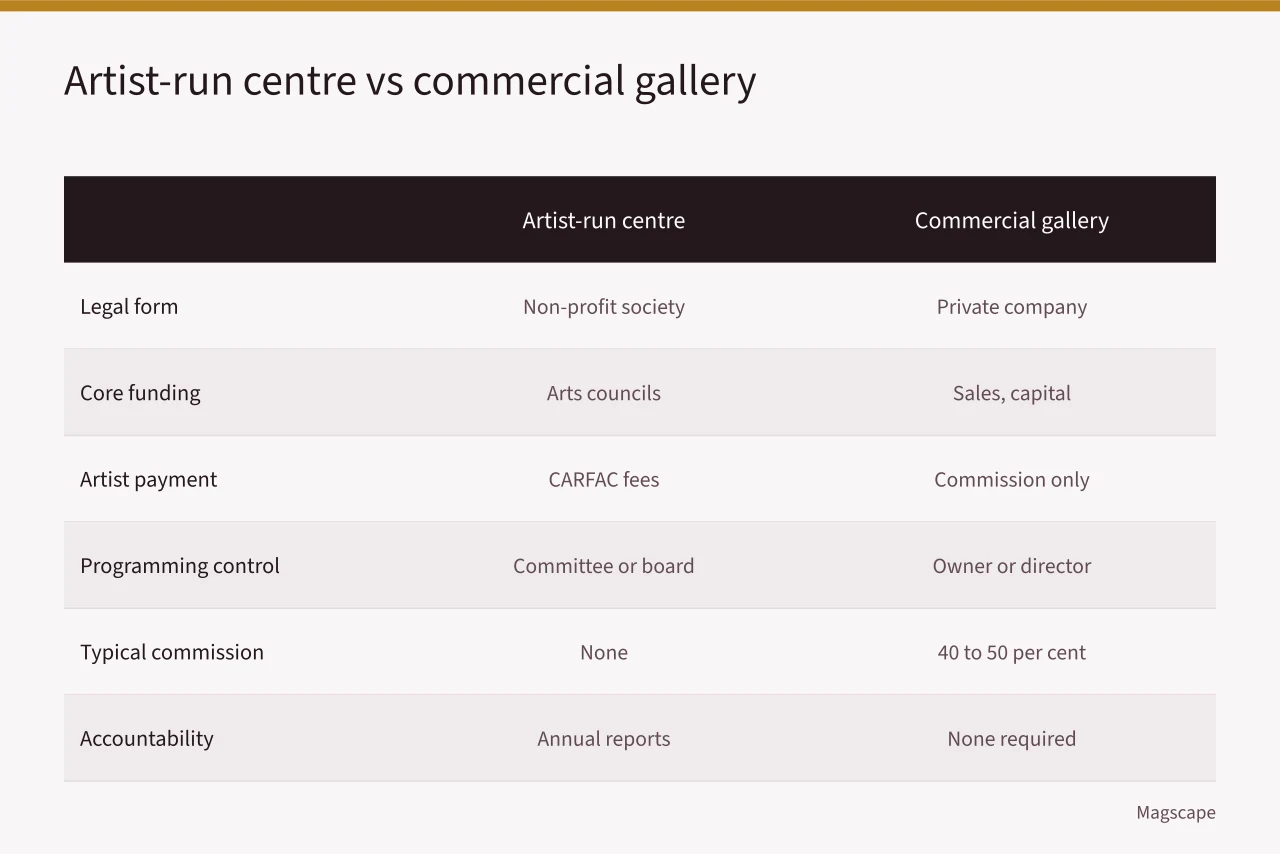
| Criterion | Artist-run centre | Commercial gallery |
|---|---|---|
| Legal form | Non-profit society or charity | Private company or sole proprietorship |
| Core funding | Canada Council and provincial arts councils | Sales, private capital |
| Artist payment | CARFAC-based exhibition fees | Commission on sale only |
| Programming control | Curatorial committee or board | Owner or director |
| Typical commission | None | Roughly 40 to 50 per cent (illustrative range) |
| Public accountability | Annual reports, funder reporting | None required |
Option by option
Artist-run centre. The Canada Council for the Arts is the largest single funder of this sector, and provincial councils such as the Ontario Arts Council and the Conseil des arts et des lettres du Quebec add operating support. Fees follow the CARFAC schedule, which sets minimum payments for exhibition, reproduction and artist talks. A centre can program difficult work because a grant, not a buyer, covers the cost.
Commercial gallery. The dealer fronts the space, the insurance and often the framing, then recoups through commission. A solo show in a dealer space can move an artist's prices, but only if the work sells. The gallery decides.
Hybrid cases. Some Canadian dealers run non-profit or project spaces alongside the commercial room. Some artist-run centres sell editions. Treat the two models as poles, not boxes, and check the incorporation documents before describing either one.
Where each one wins
An artist-run centre is right when the work is research-based, durational, installation-heavy or otherwise hard to sell. It is also the better route for an early-career artist who needs a documented exhibition and a fee, not a price list.
A commercial gallery is right when there is a collector base, a consistent body of saleable work and an artist ready to hold prices steady across shows. Dealers also do work no centre does: they place pieces in private and public collections and manage an artist's market over years.
For a critic, the choice of venue changes the review. A centre show invites an argument about the work. A dealer show invites a question about the market. The theater and performance coverage forms compared piece makes a similar point about matching form to venue.
What none of them solve
Both models leave the same gap: neither guarantees an income. Grants are project-based and competitive, and sales are cyclical. A 2023 sector survey by Canadian Art Foundation put median annual earnings for visual artists well below the national average, though the figure varies by province.
A grant is not a wage. A commission is not a wage either. An artist can hold a centre show and a dealer show in the same year and still need other work.
There is also a shared blind spot on documentation. Centres and dealers both keep records for their own purposes, and neither is obliged to open them to a journalist. Provenance research tools, such as the Getty provenance research databases, are useful when a work's history matters more than its price.
How to tell which one you are in
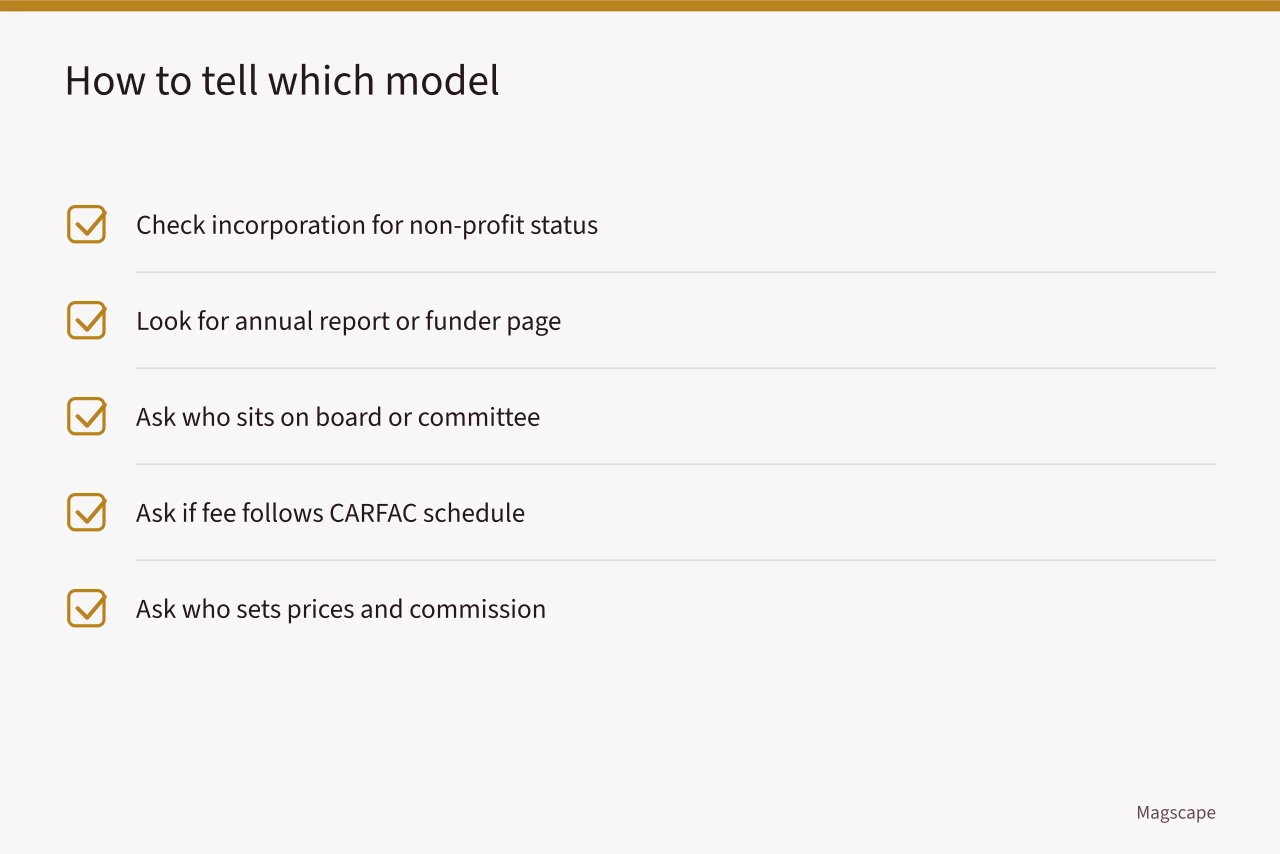
- Check the incorporation: search the federal charities listing or the provincial registry for non-profit status.
- Look for an annual report or funder acknowledgment page on the website.
- Ask who sits on the board or curatorial committee, and whether artists hold the majority.
- Ask whether the exhibition fee is paid on the CARFAC schedule or negotiated.
- Ask who sets prices, and whether the gallery takes commission or a consignment split.
Common questions
Do Canadian artist-run centres pay artists? Yes, most pay exhibition fees based on the CARFAC schedule, funded through operating and project grants. Payment is usually a flat fee rather than a share of sales.
What commission does a commercial gallery take in Canada? A common range is 40 to 50 per cent of the sale price, though this is illustrative and varies by city, artist and career stage. Always confirm the consignment terms in writing.
Can an artist show in both? Yes, and many do. The risk is a price conflict if a centre show undercuts a dealer's pricing. Agree in advance which venue sets the retail price.
Is an artist-run centre the same as a public gallery? No. Public galleries are usually municipally or university funded with permanent collections. Artist-run centres are artist-governed, have no collection, and depend on arts council grants.