Guides
What Does a Public Art Commission Cost in Chicago This Year?
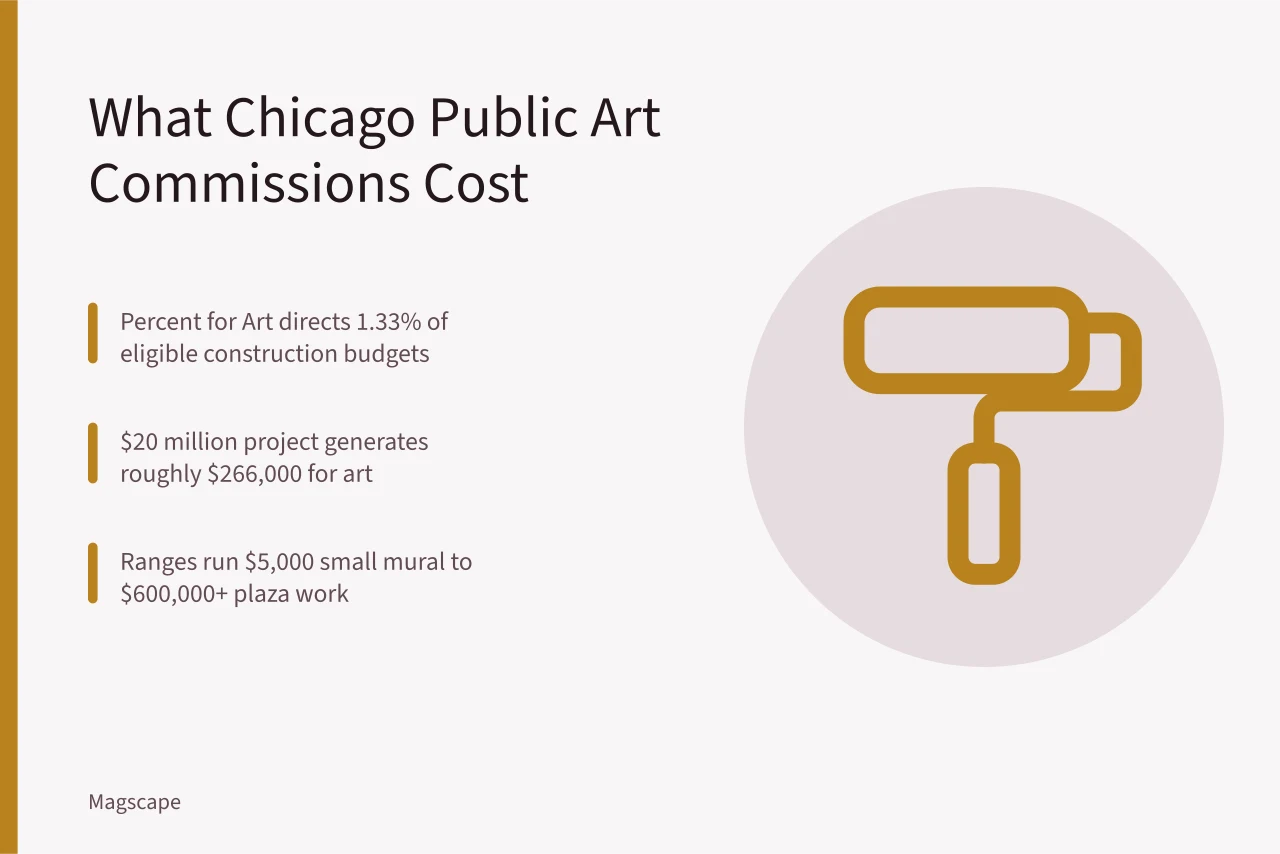
Public art commission cost Chicago ranges from $5,000 for a small mural to $600,000 and up for a major plaza work under the Percent for Art ordinance.
What to take away
- Chicago's Percent for Art ordinance directs 1.33 percent of eligible municipal construction budgets to public art, so the city's own spending is the clearest local benchmark.
- Realistic commission ranges in Chicago this year run from roughly $5,000 for a small interior mural to $600,000 and up for a major plaza or transit work. Figures here are illustrative unless tied to a named program.
- Percent for Art money covers design, fabrication and installation. Maintenance, insurance and deinstallation usually sit outside it.
- One-off costs (artist fee, fabrication) behave nothing like recurring costs (conservation, lighting, security). Budgets fail when the two are blended.
- The National Endowment for the Arts Our Town program funds public art tied to placemaking, and it publishes project examples with budget ranges.
How the Chicago ordinance sets the floor
Chicago's Department of Cultural Affairs and Special Events runs the Percent for Art program, and the rule is simple to state: a share of eligible construction budgets goes to artwork. The current figure is 1.33 percent. That means a $20 million library or transit project generates roughly $266,000 for art, before the artist is chosen.
That number matters for anyone pricing a commission. It tells you what a public client can plausibly spend without going back to council. A private developer or a business improvement district has no such floor, so its budget is whatever the client decides.
Compare that with other cities. New York City sets aside 1 percent of its capital budget for public art through its Department of Cultural Affairs. Many US cities cluster between 1 and 2 percent. Chicago sits near the middle, which makes it a reasonable yardstick for a national reader.
Line by line: what the range covers
The table below shows typical cost bands for Chicago-area commissions. Treat the dollar columns as illustrative ranges drawn from published program budgets and comparable US projects, not as quotes.
| Cost item | Low | High | One-off or recurring |
|---|---|---|---|
| Artist fee (design and oversight) | $3,000 | $60,000 | One-off |
| Fabrication and materials | $2,000 | $400,000 | One-off |
| Engineering and permits | $1,500 | $45,000 | One-off |
| Installation and rigging | $1,000 | $80,000 | One-off |
| Conservation and maintenance | $500 | $15,000 | Recurring, annual |
| Insurance and liability | $300 | $6,000 | Recurring, annual |
| Deinstallation or deaccession | $1,000 | $25,000 | One-off, end of life |
A small interior mural in a ward office might land near $5,000 to $15,000 all in. A freestanding sculpture in a park runs $75,000 to $250,000. A major plaza or transit station commission with integrated architecture can pass $600,000.
Fixed against variable
The distinction that trips up first-time budget writers is fixed versus variable. Fixed costs are known before the contract is signed: the artist fee, the engineering stamp, the permit fees. Variable costs move with site conditions, weather and how long the piece stays up.
Maintenance is the classic variable. A painted mural in Chicago's climate needs repainting every five to ten years. A bronze sculpture needs waxing and patching. Neither cost appears in the commissioning contract, and both arrive years later.
A useful discipline is to set the maintenance reserve at the moment of commissioning, not after. Two to four percent of the total project cost per year is a common planning figure, though it varies with material and exposure.
A commission that cannot name its annual maintenance figure is not fully budgeted, no matter how complete the fabrication quote looks.
What the program does not include
The Percent for Art allocation covers the artwork itself. It does not cover the site's landscaping, the lighting grid, or the plaque. It does not cover the staff time spent on selection panels, and it does not cover legal review of the artist contract.
Those costs fall to the commissioning department. On a $20 million project they are small in percentage terms but real in absolute terms, often $10,000 to $40,000 across a two-year process.
Private commissions have a wider gap. A developer working with a business improvement district may get no public money at all, which means the entire budget is negotiated. The Chicago public art program overview lays out the city's process and funding structure for anyone who wants the primary source.
The NEA's Our Town grant program funds public art tied to placemaking and publishes project examples with budget ranges, which is useful when a client asks what comparable cities spend.
Where budgets leak
Four leaks show up again and again.
The first is site preparation. A wall that looks flat is not flat, and patching, priming and structural work can add 20 to 30 percent to a mural budget.
The second is the artist's travel and housing. For a commission that takes months, per diem and lodging are real line items that clients forget to authorize.
The third is photography and documentation. A completed commission needs professional images for the city's archive, the artist's portfolio and any press. Budget $1,500 to $8,000.
The fourth is the end of life. Public art gets removed, relocated or deaccessioned, and that costs money. Ask early who pays, and get it in writing.
For a wider view of how public art commissioning works across US cities, the Wikipedia entry on public art covers process and cost structures. Writers comparing Chicago with other markets may find the comparison of regional festival economies useful for how public money shapes a local arts sector. Anyone drafting a commissioning brief should read the performance reporting guide for how to describe a project's scope in plain terms.
Common questions
What percentage does Chicago set aside for public art? The Percent for Art ordinance directs 1.33 percent of eligible municipal construction budgets to public art, administered by the Department of Cultural Affairs and Special Events.
What does a small Chicago commission actually cost? A small interior mural typically runs $5,000 to $15,000 all in, while a freestanding park sculpture runs $75,000 to $250,000. These are illustrative ranges, not quotes.
Who pays for maintenance after installation? Usually the owning department or agency, not the artist. Set a reserve of two to four percent of project cost per year at commissioning time.
Do private commissions follow the same rules? No. The 1.33 percent floor applies to eligible city construction. Private and business improvement district projects negotiate their own budgets.