Guides
How to write arts criticism and reviews: a practical guide
This guide explains how to write arts criticism and reviews: defining the assignment, reporting, building an argument, interviewing, disclosure, and fact-checking.
What to take away
- Decide first whether the job is news, criticism, a profile, a preview or a reported essay; each promises the reader something different.
- Record what you actually sawwhich performance, which cut, which rooms, which works were unavailable.
- Keep description, interpretation and evaluation in separate sentences so a reader can tell them apart.
- Log every free ticket, trip, meal and loan, and disclose what a reader would want to know.
- Check names, roles, dates, materials, quotations, translations, image credits and money figures against a primary source before filing.
Arts coverage explains how work gets made, funded, shown and argued about. Criticism adds a judgment about the work itself. Both use reporting. They do not make the same promise to the reader.
A review can say a production fails on its own terms. A news report has to establish what happened and who says what before anyone analyzes it.
Photo and credit
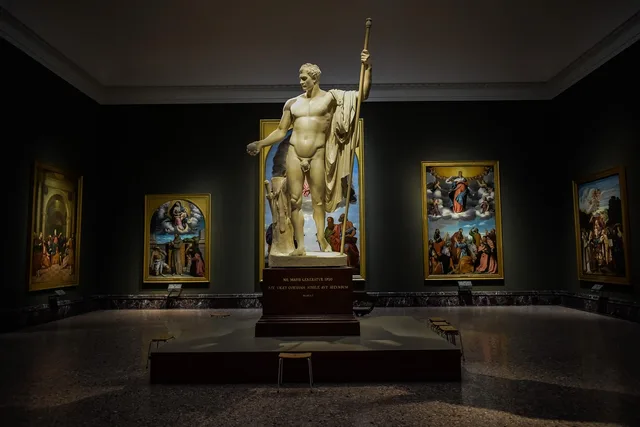
The image records one gallery visit. It shows nothing about this publication's reporting and nothing about the artwork on the wall.
Define the assignment
Write down the central question, the reader you are writing for, the format, the deadline, the word budget and the access you have. Then name the form: a review built on firsthand attendance, or a preview built on interviews and supplied material. Never file a preview as though the critic saw a finished work.
Assignment setup checklist
- Central question
- Target reader
- Format
- Deadline
- Word budget
- Access
- Formreview or preview
For anything time-based, record which performance, cut, cast or program you attended. For an exhibition, note the venue, the rooms you walked, works that were off display, and whether you had the labels and catalog.
Report before deciding
Collect the official title, creators and their roles, venue, dates, running time and materials. Collect production credits, ticket prices, commissioning history and the context the institution states. Where a claim matters, verify it outside the press release.
Conditions to log
- Scale
- Sequence
- Sound
- Light
- Pace
- Framing
- Sight lines
- Captions
Then log conditions:
- scale
- sequence
- sound
- light
- pace
- framing
- sight lines
- captions
- transitions Concrete beats adjective. A timestamp, a gallery position, a page number or a track number is evidence. A notebook of adjectives is not.
Build the critical argument
A review usually moves through four operations:
Four operations of a review
- Descriptionwhat is present and arranged
- Interpretationeffects of those choices
- Contexthistory, genre, place, debate
- Evaluationmeets, resists, complicates aims
- Description.What is present, and how is it arranged?
- Interpretation.What effects follow from those choices?
- Context.What history, genre, place or live debate explains the work?
- Evaluation.How well does it meet, resist or complicate its own aims?
State the criterion behind the verdict. "The show is confusing" is thin. Say instead whether the chronology breaks without purpose, whether the labels assume knowledge the room never supplies, or whether the hang contradicts the curator's own argument. A work can succeed on one count and fail on another; say so.
Interview without surrendering the story
Ask makers about choices, process, sources, constraints and collaboration. Ask institutions about selection, finance, access, loans and rights, and read their accounts rather than their press lines. Loan requests, condition reports and rights clearances are where a show's real constraints sit.
Give anyone facing a serious factual allegation a fair chance to answer. Do not send a full review for approval. Checking a disputed technical phrase is not the same as handing over tone or conclusion.
Work independently and transparently
The Associated Press statement of news values and principles asks its journalists to report accurately and honestly and to avoid behavior that creates a conflict of interest. Such standards are voluntary guidance, not law.
Set a written policy for these areas:
- travel
- accommodation
- meals
- gifts
- friendships
- employment
- collecting
- sponsorship Disclose any relationship a reader would use to judge the piece. If disclosure cannot cure it, reassign the work.
Fact-check and publish
Build a claim list before you file. Check names and pronouns, title styling, dates, locations and creator roles. Check quotations, translations, materials, ownership wording and historical claims. Check money figures and image credits.
Poynter's nine-question credibility checklist asks who else to talk to, what is missing, and whether opinion is labeled. Attribute interpretation to the critic. Attribute disputed claims to their sources.
Correct factual errors promptly and visibly after publication. A changed opinion is not a factual correction. A review may still need an editor's note if essential access, identity or conflict information was left out.
Common questions
Must a critic interview the artist?
No. An interview can clarify process and settle facts, but the work and the assignment decide whether it is needed. A review of a finished piece can stand on the piece.
Can a review be written from a recording?
Yes, when the assignment names the recorded object and the critic does not imply attendance. Note what the recording cannot show, such as scale, sight lines or an audience's attention.
Is strong opinion unprofessional?
No. A strong verdict holds up when criteria, evidence, context and fair description support it. Weak judgment is the problem, not strong judgment.
Should a negative review be softened to protect access?
No. Edit for accuracy, proportion, evidence and unnecessary harm. Do not edit for favorable treatment on the next press night.
In this guide
- How to write an art exhibition review from firsthand observationArt exhibition review method for firsthand observation, object research, visual evidence, critical criteria, argument structure, and final fact-checking.
- Arts reviews, reports, profiles, previews, and essays comparedCulture coverage forms compared across arts reviews, news reports, profiles, previews, interviews, and critical essays by purpose, evidence, voice, timing, and risk.
- Arts reporting and criticism prepublication checklistArts reporting checklist for assignment form, firsthand access, observation, object records, interviews, attribution, conflicts, rights, facts, and corrections.
- Arts coverage problems with practical editorial fixesArts coverage fails in predictable ways: borrowed press copy, hidden access, loose attribution and thin corrections. Here is how editors catch each one.
- Case study: correcting a fictional exhibition attribution storyFictional arts reporting case tracing an overstated attribution and incomplete provenance through evidence review, correction, follow-up, and workflow repair.