Guides
How US Museums Report Indigenous Land Acknowledgements
A working method for reporters verifying US museum Indigenous land acknowledgement claims, with NAGPRA records, provenance files and Canadian comparisons.
What to take away
- A land acknowledgement is a claim, not a policy. Ask for the written policy, its adoption date, and the staff member who owns it.
- Consultation leaves a paper trailmeeting dates, named tribal nations, honoraria, and advisory council minutes.
- NAGPRA filings appear in the Federal Register, which gives reporters dated public records to check.
- Provenance files and loan agreements show whether a museum can trace how an object arrived.
- Canadian public art rules require documented Indigenous consultation, so they work as a comparison point.
What reporters should verify first
A lobby sign that names the original inhabitants of a region is easy to print and hard to check. The useful question is what sits behind the text.
Reporters can sort any claim into three parts. There is the acknowledgement text, the consultation process, and the money that pays for both. Each part leaves different records.
A press release often blends all three. The records do not.
If a museum cannot supply a name, a date, or a line item, the statement is decoration.
Documents to request
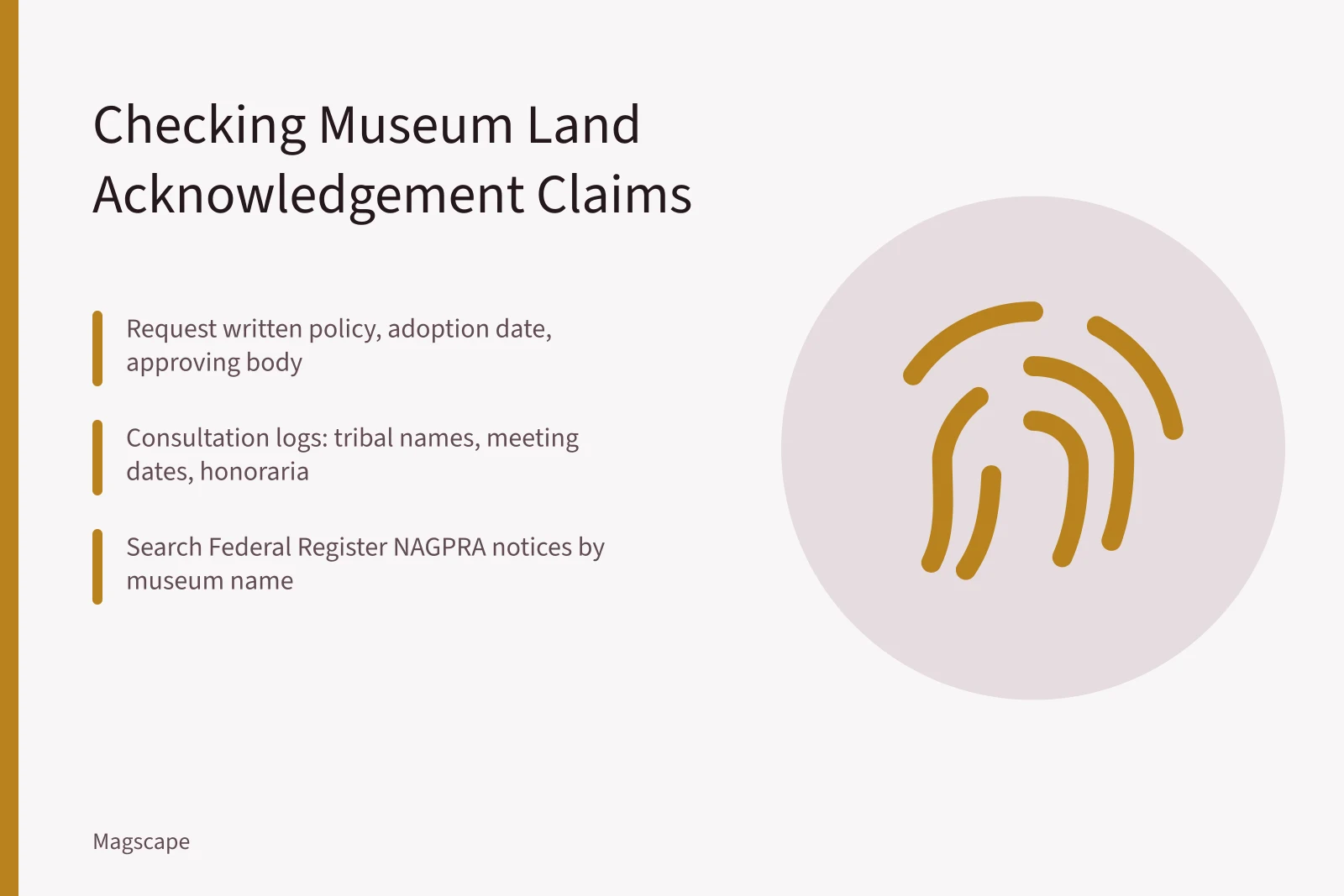
- The museum's written land acknowledgement policy, including the adoption date and the approving body.
- Consultation logs for the last three exhibitions of Indigenous art, with tribal names and meeting dates.
- The budget line for tribal liaison staff, advisory councils, or paid cultural consultants.
- Federal Register notices filed under NAGPRA, or a written statement that no covered holdings exist.
- Loan agreements and provenance files for objects with gaps in ownership history.
Send the list to the press office and the registrar on the same day. Registrars keep object files. Press offices keep messaging. Expect slow replies, because object questions cross departments.
Example: Matching public claims to records
Matching public claims to records
| Public claim | Record that tests it |
|---|---|
| "We consult tribal nations" | Consultation logs with dates and named nations |
| "We honor ancestral land" | Advisory council charter and meeting minutes |
| "We support repatriation" | Federal Register notices with filing dates |
| "Indigenous voices shape programming" | Curator contracts, honoraria, co-authored labels |
A claim paired with an empty column is the story. A claim paired with a dated document is context.
Verifying federal consultation records
NAGPRA, the Native American Graves Protection and Repatriation Act, sets legal duties for museums that hold certain items and receive federal funds. Notices of inventory completion and intent to repatriate are published in the Federal Register. Each notice names the institution and the tribal nations involved.
A reporter can search those notices by museum name and build a timeline in an afternoon. Gaps between a museum statement and its filings are worth a direct question.
Ask for the record that would exist if the claim were true. Then ask to see it.
Reading provenance and ownership records
Indigenous art cases often turn on ownership chains, not only consultation. Provenance research tools from the Getty Research Institute help reporters trace how objects moved between owners, dealers, and institutions.
A gift or bequest with no earlier owner history deserves a follow up call to the registrar. Ask when the object entered the collection and who signed the transfer.
Loan agreements matter too, especially for touring shows where the lender and the borrowing venue split responsibility.
Cross-border comparison: Canadian consultation mandates
Canadian public art policy changed after the Truth and Reconciliation Commission Calls to Action. Several jurisdictions now require Indigenous consultation on selection panels. The Canadian consultation mandates differ by province and city, so they give US reporters a written benchmark to compare against.
US museums face no equivalent requirement. That gap is the story when a museum claims consultation without documentation.
The Canada Council for the Arts publishes its grant programs, which helps trace who funds Indigenous-led work north of the border.
Touring exhibitions add customs and visa questions. Reporters who cover post-Brexit touring rules already check carnets, short stay visas, and cabotage limits when a show crosses borders.
Where the money sits
Consultation capacity follows funding. Fellowship and grant money clusters in a few metro areas, and a museum outside those cities may have no paid tribal liaison at all.
The coastal bias in US arts fellowship clustering can be mapped from public data before funding a full audit.
NEA research publications on the geographic distribution of grants give a baseline before any calls are made.
Staff titles also help. A full time tribal liaison with a budget differs from a volunteer advisory group that meets twice a year.