Guides
How US Tribal Museums Write Land Acknowledgements: A Reporter's Guide
A source-side guide for reporters: how Native-run US and Canadian museums word, approve and update land acknowledgements, plus NAGPRA and provenance checks.
What to take away
- Native-run museums tend to name the host nation, the treaty, and the approving body near the top of a statement.
- The source side, meaning the tribal museum itself, gives reporters a standard to compare other institutions against.
- Ask who wrote the wording, who approved it, and when it was last revised.
- Verify claims through federal NAGPRA notices, object provenance records, and grant data.
- Canadian Indigenous-run centres work from treaty and land claim language that differs from US practice.
Why the source side sets the standard
Most news coverage of land acknowledgements begins with the museum that posted one. That order hands the framing to the institution. A guide for reporters should reverse it and begin with the nations that host the collections in question.
Tribally governed museums answer to a council or a cultural authority, not to a self-selecting board. The Navajo Nation Museum in Window Rock, Arizona, the Ziibiwing Center in Mount Pleasant, Michigan, and the Mashantucket Pequot Museum in Connecticut are three such institutions.
Because the governing nation writes the text, the acknowledgement functions as policy. It can change by a vote, a new research finding, or a leadership transition. Non-Native museums rarely describe their statements that way. The practical detail is set out in How Arts Council England Creative Scotland.
What Native-run statements tend to include
Treat this list as a reading checklist, not a template.
- The nation named in its own preferred spelling rather than a colonial variant.
- The treaty, cession, or executive order connected to the site.
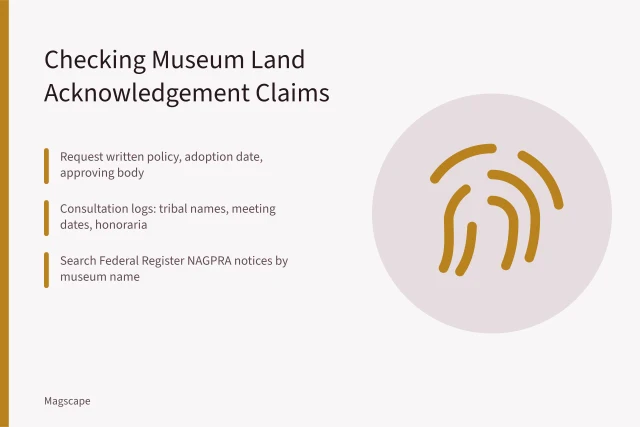
- The body that approved the language, such as a tribal council or cultural committee.
- A date of adoption and a date of last revision.
- A contact inside the nation for corrections.
Three questions that produce a usable answer
- Who wrote the text? A statement drafted by a marketing office carries different weight from one drafted by a cultural department.
- Who approved it? Ask for the resolution, policy number, or meeting record.
- When was it revised? A date tells you whether the museum treats the statement as a living document.
Example: two opening lines
A tribal museum press release often names the host nation in its first sentence, then the territory, then the exhibition. A non-tribal museum frequently reverses that order and puts the acknowledgement after ticket and parking details.
The table below lists the parts a reporter can label while reading.
Element / What Native-run museums often include
- Opening line
- Host nation named first
- Territory
- Specific treaty or cession
- Authority
- Tribal council or cultural committee
- Revision
- Dated review cycle
- Corrections
- Named contact inside the nation
How to verify a claim
- Pull the federal notices. The National NAGPRA Program publishes inventory and repatriation notices by institution, and the 2024 regulatory revisions shortened the timelines museums work under.
- Check the objects. Provenance research tools from the Getty Research Institute trace ownership chains for collection items, including items on loan for exhibitions.
- Follow the funding. NEA research publications show how arts grants spread across states and territories, which helps a reporter see whether money reaches tribal institutions.
- Compare the wording. Set the institutional statement beside the working method for reporters verifying museum claims, which pairs NAGPRA records with provenance files.
Canadian museums and treaty language
Indigenous-run centres in Canada sit inside a different legal frame. Numbered treaties, modern land claims, and the Indian Act shape what a statement can say and who must be consulted.
The U'mista Cultural Centre in Alert Bay, British Columbia, and the Haida Gwaii Museum at Kay Llnagaay are useful comparisons for US reporters. Both operate under First Nations governance.
The Canada Council for the Arts runs dedicated Indigenous arts funding streams, so budget documents there often name the nation alongside the program.
Where the statement appears
Statements surface in more than one place. Check the press release boilerplate, the wall text at the entrance, the exhibition catalogue colophon, and the annual report. Each version may differ.
When versions differ, quote the most recent and note the date. Ask which office controls the master text. A museum with no statement at all is also a finding worth reporting.