Reviews
Part of Festival, subculture, and community arts reporting guide
Community culture coverage forms compared
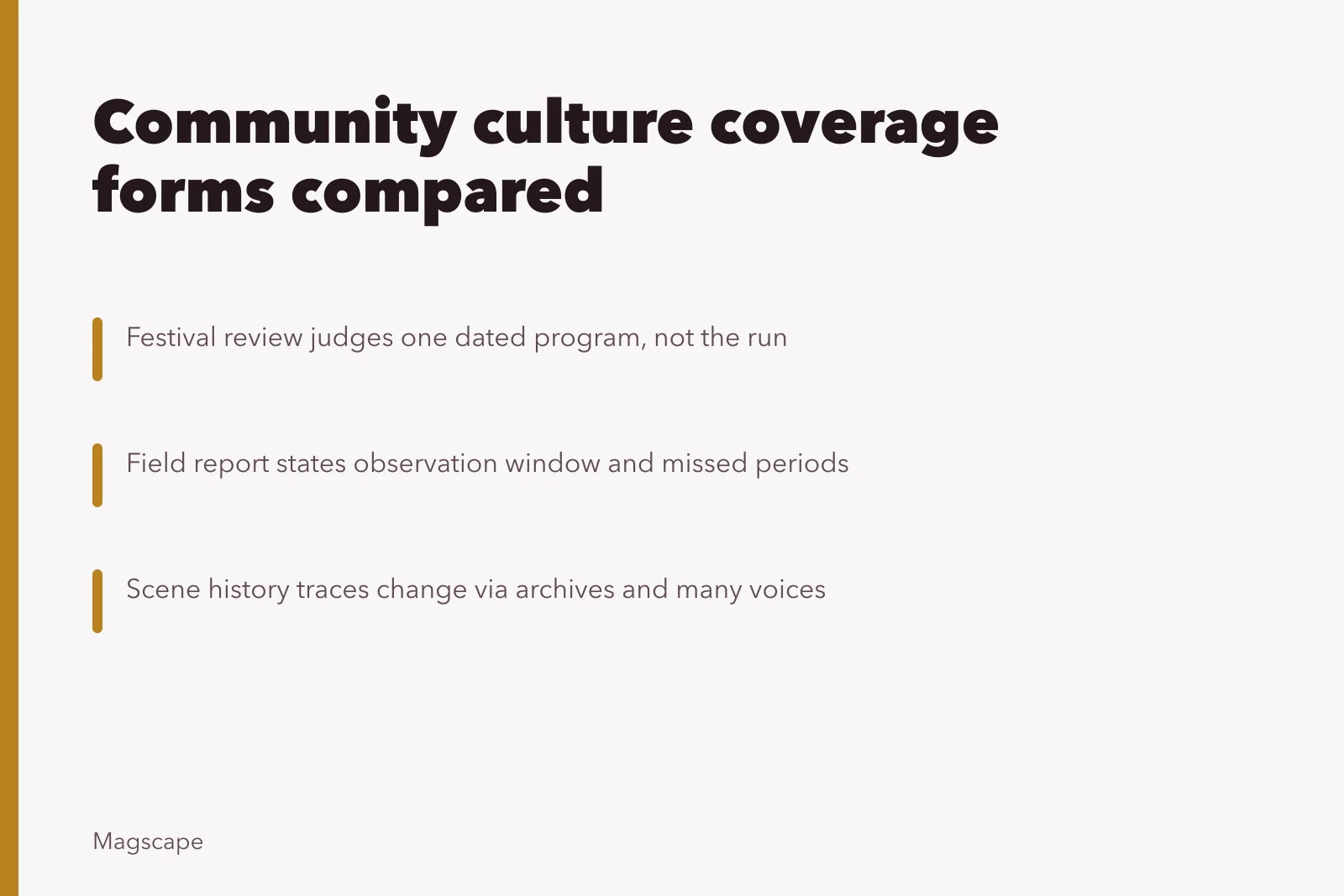
Community culture formats compared across festival reviews, field reports, scene histories, profiles, issue stories, process reports, and documentation projects.
What to take away
- A festival review judges a dated program; a field report explains what occurred across a bounded visit.
- A scene history traces change through records and several generations or roles.
- A participant profile centers one person's practice without making that person represent everyone.
- An issue story investigates power, money, access, conflict, or policy across interested parties.
- A documentation project creates records for later use and therefore needs consent, organization, and preservation.
Festivals, scenes, and community arts can support several article forms, but each owes readers different evidence. Choose the form before reporting so access to one charismatic source does not redefine the assignment.
Comparison table
Main question
- Festival review
- How did the program work on this date?
- Field report
- What happened during a bounded visit?
- Scene history
- How did a community practice change?
- Participant profile
- How does this person work and understand the practice?
- Issue story
- Who holds power and what is disputed?
- Process report
- How was an event or work made?
- Documentation project
- What record should remain?
Core evidence
- Festival review
- direct observation, schedule, credits
- Field report
- timed notes, routes, interviews
- Scene history
- archives, spaces, objects, many voices
- Participant profile
- interview, observation, examples
- Issue story
- documents, money, policy, responses
- Process report
- decisions, labor, revisions, records
- Documentation project
- consent, recordings, logs, metadata
Common failure
- Festival review
- generalizing from one stage
- Field report
- hiding missed periods
- Scene history
- inventing a unified origin
- Participant profile
- making one person representative
- Issue story
- treating conflict as atmosphere
- Process report
- crediting only the lead
- Documentation project
- collecting without future care
Festival review
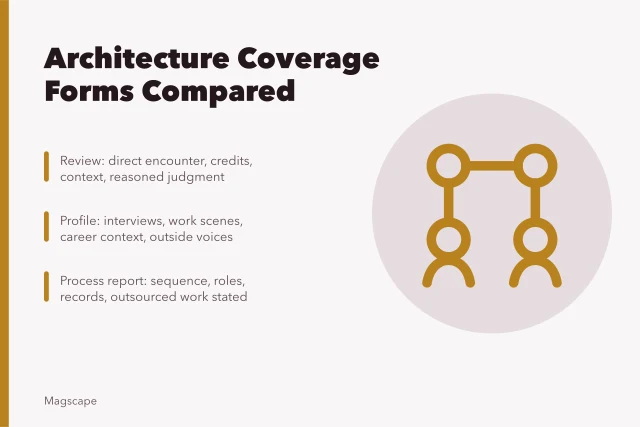
Identify the date, venue, program version, time attended, and missed events. Review artistic choices, cultural framing, spatial design, hosting, access, and audience relation through observed detail. Do not turn one delayed performance into a claim about the entire run.
Festival review checklist
- Identify date, venue, program version
- Note time attended and missed events
- Review artistic choices and cultural framing
- Observe spatial design, hosting, access
- Describe audience relation through detail
- Avoid generalizing from one delayed performance
The National Endowment for the Arts national outdoor arts festival study surveyed programming, operations, budgets, audiences, ticketing, and public access across a large set of festivals. Its findings show why a review should not assume all festivals share one business model or admissions structure.
Field report
A field report is wider than a review and narrower than an event history. It records movement among stages, stalls, workshops, queues, entrances, and surrounding streets. Time stamps and position matter because crowds and programs change by hour.
Field report essentials
- State observation window early
- Record movement among stages and stalls
- Note queues, entrances, surrounding streets
- Use time stamps and position
- Separate seen from reported periods
State the observation window early. Separate what you saw from what organizers or participants reported about other periods.
Scene history
Trace places, people, media, events, language, technology, economics, and internal debate across time. Seek early participants, newer entrants, organizers, venue workers, archivists, critics, and people who left. Avoid a single founder story unless records and several sources support it.
Participant profile
Center one maker, performer, organizer, vendor, collector, dancer, writer, or tradition bearer. Show practice through scenes and specific work. Place the subject in a community without asking them to define everyone else's identity or experience.
Issue story
Investigate a concrete question such as artist payment, permit denial, venue loss, policing, sponsorship, cultural ownership, neighborhood disruption, accessibility, or leadership conflict. Identify the decision maker, records, affected parties, response deadline, and possible outcomes.
Process report
Follow planning, selection, rehearsal, fabrication, installation, delivery, cleanup, and review. Map who could make, revise, approve, or veto each part. Include invisible labor such as translation, transport, sound, care, access coordination, and waste removal when relevant.
Documentation project
This form creates an organized record, not just a publishable story, and may include interviews, field notes, photographs, audio, and video. It may include schedules, flyers, metadata.
Smithsonian's cultural heritage presentation series describes community engagement, cultural self-representation, language diversity, first-person voices, and collaborative decisions about what tradition bearers wish to present. Documentation should preserve those choices, not strip material from relationships.
Plan storage, access, restrictions, file naming, logs, rights, and deposit before collecting. A newsroom archive is not automatically an appropriate long-term repository.
Choose the form
Use a review for judgment, field report for a bounded event account, scene history for change, profile for a person, issue story for public stakes, process report for production, and documentation project for a reusable record. Combine them only when every form receives its required evidence.
Common questions
Can a field report include criticism?
Yes, if judgments stay tied to the reporter's stated route and observation window.
Is a scene history the same as an oral history?
No. Recorded memories may be sources within a scene history, which also needs other evidence and context.
Can an issue story be based on social posts?
Posts may document public statements or leads. Consequential claims still need checking and response.
Must documentation be public?
No. Consent, cultural protocols, safety, and repository agreements may require limited or delayed access.