Reviews
Part of Architecture, craft, and design reporting guide
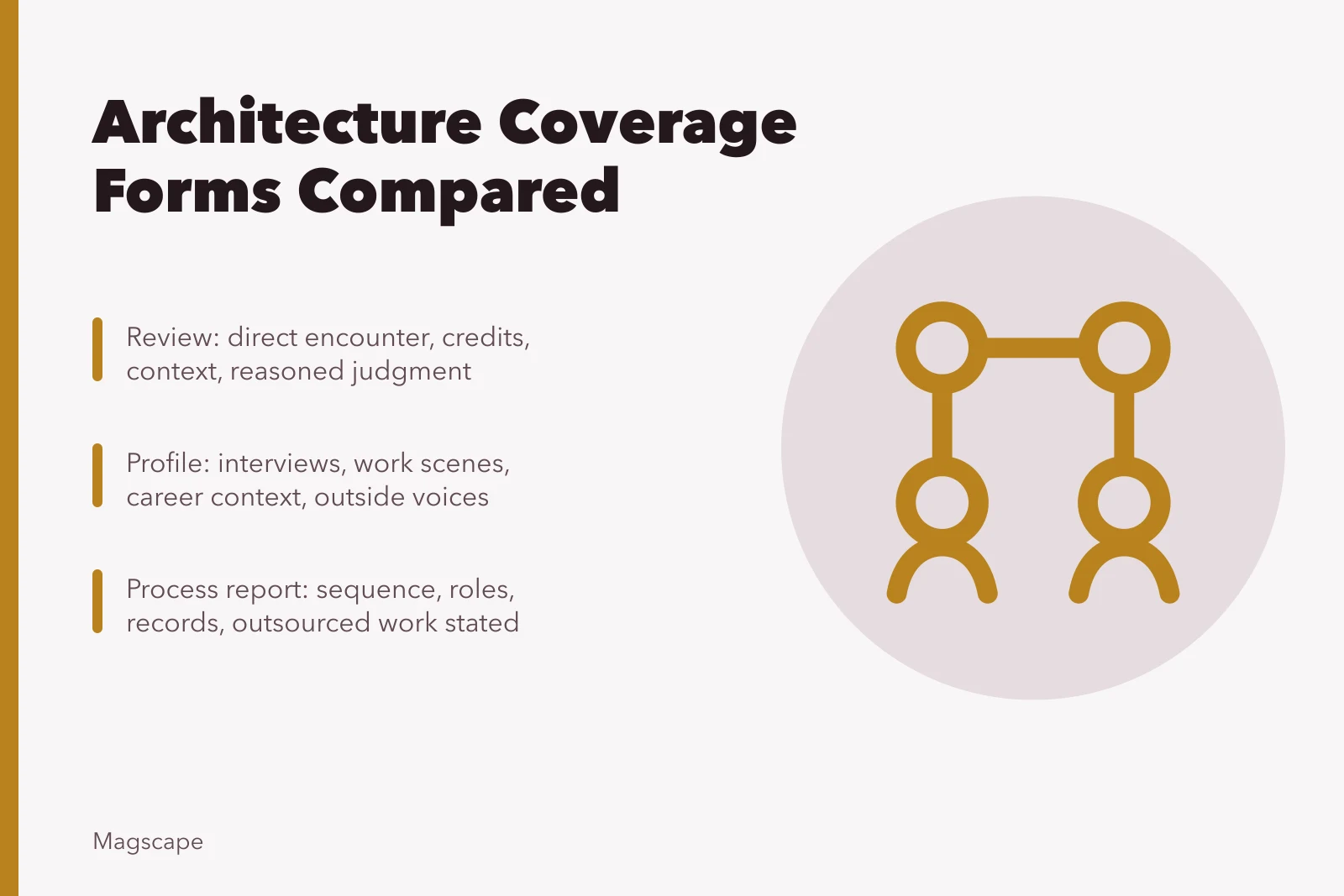
Architecture, design, and craft coverage forms compared
Architecture and design coverage comparison defining reviews, profiles, process reports, building histories, product tests, conservation stories, and visual essays.
What to take away
- A review judges a work encountered under stated conditions; a profile explains a person or practice.
- A process report follows decisions and labor; a building history reconstructs change over time.
- A product test needs a declared protocol; a visual essay needs captions and sequence.
- Conservation stories separate original fabric, later change, condition, and proposed treatment.
- Choose the form before reporting so the evidence matches the article's promise.
Architecture, design, and craft coverage uses several forms that owe readers different evidence. An interview cannot replace independent observation in a review. A single site visit cannot establish a century of building history. A short trial cannot support a broad durability claim.
Quick comparison
Main question
- Review (Ada Louise Huxtable, The New York Times, 1963 to 1982; Michael Kimmelman, same paper, from 2011)
- How does this work perform and signify?
- Profile (The New Yorker's Profiles; Apartamento, founded 2008; Kinfolk, founded 2011)
- How does this person or studio work?
- Process report (Fine Woodworking, Taunton Press, since 1975; Chris Lefteri's Making It, 2007)
- How was this made or built?
- Building history (Nikolaus Pevsner's The Buildings of England, from 1951; Historic American Buildings Survey, since 1933)
- How did this place change?
- Product test (Consumer Reports, which buys at retail; Wirecutter, bought by The New York Times in 2016)
- What happened under a stated trial?
- Conservation story (Getty Conservation Institute, founded 1985; APT Bulletin; Secretary of the Interior's Standards)
- What exists, what changed, what is proposed?
- Visual essay (Berenice Abbott's Changing New York; Ed Ruscha's Every Building on the Sunset Strip, 1966)
- What can a sequence of images reveal?
Required evidence
- Review (Ada Louise Huxtable, The New York Times, 1963 to 1982; Michael Kimmelman, same paper, from 2011)
- Direct encounter, credits, context
- Profile (The New Yorker's Profiles; Apartamento, founded 2008; Kinfolk, founded 2011)
- Interviews, examples, outside context
- Process report (Fine Woodworking, Taunton Press, since 1975; Chris Lefteri's Making It, 2007)
- Sequence, roles, records, observation
- Building history (Nikolaus Pevsner's The Buildings of England, from 1951; Historic American Buildings Survey, since 1933)
- Plans, photographs, records, fabric
- Product test (Consumer Reports, which buys at retail; Wirecutter, bought by The New York Times in 2016)
- Sample, method, duration, results
- Conservation story (Getty Conservation Institute, founded 1985; APT Bulletin; Secretary of the Interior's Standards)
- Condition evidence, history, specialists
- Visual essay (Berenice Abbott's Changing New York; Ed Ruscha's Every Building on the Sunset Strip, 1966)
- Original images, captions, order
Frequent mistake
- Review (Ada Louise Huxtable, The New York Times, 1963 to 1982; Michael Kimmelman, same paper, from 2011)
- Treating publicity as observation
- Profile (The New Yorker's Profiles; Apartamento, founded 2008; Kinfolk, founded 2011)
- Turning access into praise
- Process report (Fine Woodworking, Taunton Press, since 1975; Chris Lefteri's Making It, 2007)
- Assigning all labor to one name
- Building history (Nikolaus Pevsner's The Buildings of England, from 1951; Historic American Buildings Survey, since 1933)
- Blending dates and phases
- Product test (Consumer Reports, which buys at retail; Wirecutter, bought by The New York Times in 2016)
- Claiming universal performance
- Conservation story (Getty Conservation Institute, founded 1985; APT Bulletin; Secretary of the Interior's Standards)
- Calling replacement restoration
- Visual essay (Berenice Abbott's Changing New York; Ed Ruscha's Every Building on the Sunset Strip, 1966)
- Using pictures as decoration
Review: Huxtable to Kimmelman
The New York Times made Ada Louise Huxtable its first full-time architecture critic in 1963. She won the Pulitzer Prize for criticism in 1970, the first year the category was awarded, and later wrote about architecture for The Wall Street Journal. Michael Kimmelman took the Times post in 2011.
A review identifies the exact version and conditions encountered, describes the evidence, and makes a reasoned judgment. For a building, that includes access and occupied use when possible. For an object, it includes scale, handling limits, material, construction, and function.
Terminology must stay stable. The Getty Research Institute's Art and Architecture Thesaurus search page explains that the evolving vocabulary supports research and cataloging, includes contributor information, and provides search tools for exact terms and broader combinations. A controlled term can improve precision, but it does not prove that the term applies to the work being reviewed.
Profile: The New Yorker, Apartamento, Kinfolk
A profile centers a maker or a practice. The subject may be a designer, an architect, a collective, a workshop, or a maintenance practice. The New Yorker has run Profiles of architects for decades; Paul Goldberger wrote its Sky Line column from 1997 to 2011.
Apartamento, founded in 2008, and Kinfolk, founded in 2011, publish home visits that read as profiles. A profile needs scenes of work, specific examples, career context, and voices beyond the subject when claims warrant them.
Ask about constraints, revisions, clients, and failures. Ask too about credit, pricing, sourcing, and repair. Preserve the distinction between a person's account and independently verified fact. A profile may include judgment, but its core task is to explain a practice through reported evidence.
Process report: Fine Woodworking and Making It
This form follows a sequence from brief or raw material to finished work. It should identify who did each step, which work was outsourced, what changed, and why. Fine Woodworking, published by Taunton Press since 1975, prints measured drawings and step-by-step construction articles.
Chris Lefteri's Making It, first published by Laurence King in 2007, catalogs manufacturing methods with process photography. Process photographs, samples, mockups, and shop drawings can supplement direct observation. Invoices and interviews cover what the reporter did not see.
Do not imply that handmade means made by one person. Studios divide labor, machines may perform parts of the work, and specialist contractors often resolve key details. State what you witnessed and what participants reconstructed later.
Building history: Pevsner, HABS, SAH
Building history phases
- Commissionproject is initiated
- Designdrawings and proposals
- Constructionbuilding is erected
- Occupationbuilding is used
- Alterationchanges are made
- Damage and repaircondition changes
- Reuse and present conditioncurrent state
Nikolaus Pevsner's The Buildings of England began in 1951 and reached 46 volumes; Yale University Press has published new editions since 2002. The Historic American Buildings Survey, run by the National Park Service since 1933, files measured drawings and large-format photographs with the Library of Congress.
The Society of Architectural Historians' Buildings of the United States series, published by Oxford University Press, surveys American states in the same county-by-county manner.
The Library of Congress Architecture, Design and Engineering Drawings collection includes drawings for public buildings, private residences, commercial structures, other work by American architects and firms.
Such drawings can document proposals or details, but presence in an archive doesn't prove every line was built.
Pair plans with dated photographs, permits, directories, and contracts. Add oral accounts and physical evidence where they exist. Label demolished features, unbuilt alternatives, and later reconstructions.
Product test: Consumer Reports and Wirecutter
A test states the exact sample, protocol, duration, environment, user, and limits. It distinguishes measurements from impressions. Consumer Reports buys every product it tests at retail and takes no advertising. Wirecutter, bought by The New York Times in 2016, names its testers and updates guides.
If testing a chair, record body range, floor type, assembly, and adjustments. Then log sitting periods, movement, noise, and observed wear.
Do not convert one review unit into a claim about all units. Manufacturing tolerances, setup, climate, maintenance, and long-term use can change results. Disclose samples supplied by a maker and any return conditions.
Conservation story: GCI, APT, the Interior Standards
This form explains what is known about original materials and design, what changed, the present condition, and the options under review. Treatment may be proposed, in progress, completed, or contested. Those states are not interchangeable.
The Getty Conservation Institute, founded in 1985, publishes material research and field projects. The Association for Preservation Technology International, founded in 1968, publishes the APT Bulletin. The National Park Service's Secretary of the Interior's Standards set four treatments: preservation, rehabilitation, restoration, and reconstruction.
Name the qualified people responsible for examination and treatment. Avoid diagnosing structural or material failure from photographs alone. Report tests, samples, and uncertainty in language readers can trace.
Visual essay: Abbott and Ruscha
A visual essay makes an argument through sequence. Wide views establish setting; medium views show relationships; details reveal joins, wear, repair, and marks.
Berenice Abbott made Changing New York for the Federal Art Project between 1935 and 1939, ordering the city's buildings and street life into a published sequence. Ed Ruscha's Every Building on the Sunset Strip, published in 1966, unfolds to about 25 feet of pavement photographed block by block.
Captions should state place, date, viewpoint, depicted feature, and relevant limit.
Choose the form
Use a review for judgment after encounter, a profile for practice, a process report for production, a building history for change, a product test for declared trials. Use a conservation story for condition and treatment, a visual essay for image-led analysis. Combine forms only when transitions and evidence are clear.
Common questions
Can a studio visit be both a profile and process report?
Yes, if the article clearly separates the person's wider practice from the sequence observed or reconstructed.
Is a building tour a review?
Not by itself. A tour supplies access and claims that still need observation, checking, and independent judgment.
Can a press rendering anchor a visual essay?
It can document a proposal if labeled as a rendering. It cannot stand in for built conditions.
Does a product test need laboratory equipment?
No, but it needs a repeatable method and conclusions limited to that method.
How do Consumer Reports and Wirecutter differ on evidence?
Consumer Reports buys every sample at retail and rates it. Wirecutter names its testers, states the method, and revises the guide as models change.