Rules
Part of Heritage, archives, and public history reporting guide
Common public history reporting problems
Public history reporting fixes for isolated documents, archive silence, memory, captions, date confusion, plaque claims, access limits, and corrections.
What to take away
- A vivid document still needs creator, purpose, hierarchy, and surrounding records.
- Archive silence may reflect record creation, collecting, loss, description, restriction, or search limits.
- Memory and official records require different questions, not a contest for automatic authority.
- Historical photographs need dates, viewpoints, caption histories, and evidence outside the frame.
- Plaques, tours, and exhibitions are sources for present interpretation as well as claims to verify.
Public history fails when evidence is stripped of the systems that produced, preserved, and described it. These repairs keep the article readable without hiding uncertainty.
Problem 1: the striking item becomes the whole archive
A letter, photograph, or memo supplies the lead, then silently represents an institution, neighborhood, or era.
Document analysis worksheet steps
- Meet the document
- Observe its parts
- Make sense of it
- Use as historical evidence
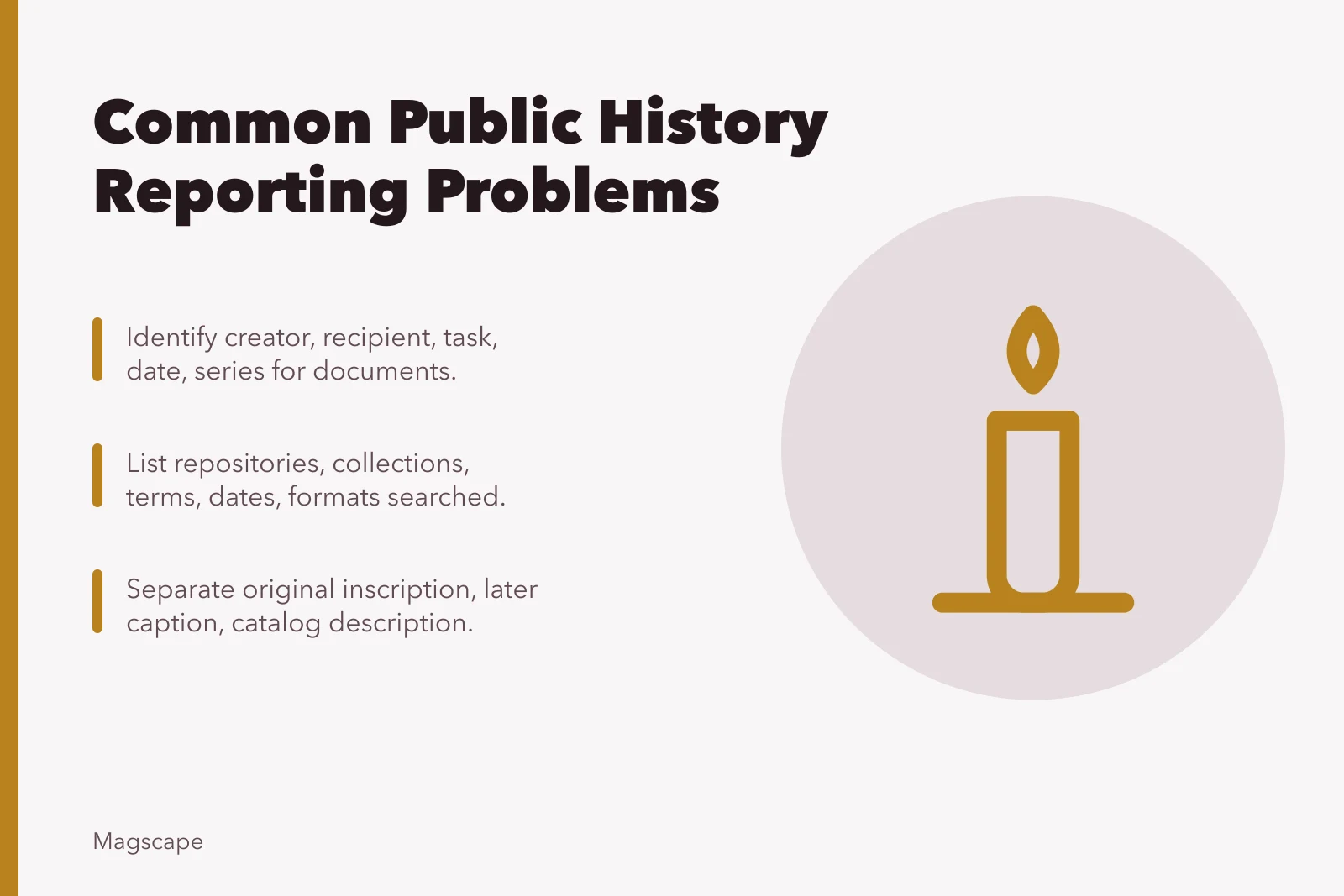
Fix: identify its creator, recipient, task, date, series, and relation to nearby records. Sample other files and state why the item is typical, exceptional, or simply revealing.
The National Archives education team's document-analysis worksheets move from meeting a document to observing its parts, making sense of it, and using it as historical evidence. The last step matters: description alone does not establish how broadly a record supports a claim.
Problem 2: absence is assigned one cause
No catalog result becomes proof that records were destroyed or that an event never occurred.
Search-limit documentation checklist
- List repositories searched
- List collections searched
- List search terms used
- List dates and formats
- Ask about unprocessed material
- Ask about restricted material
- Ask about uncataloged material
- Ask about privately held or non-surviving material
Fix: list repositories, collections, terms, dates, and formats searched. Ask about unprocessed, restricted, uncataloged, privately held, and non-surviving material. Call the result a search limit unless evidence identifies the cause.
Problem 3: official paper automatically defeats memory
A typed report is treated as objective while oral testimony is dismissed as unreliable. Official records also reflect purpose, power, vocabulary, and omission.
Official records vs oral history
Official records
- Best for
- Documented action
- Watch for
- Purpose, power, omission
- Test with
- Other evidence
Oral history
- Best for
- Experience and meaning
- Watch for
- Memory and reliability
- Test with
- Public facts
Fix: check public facts while asking what each source was positioned to know. Use oral history for experience and remembered meaning, administrative files for documented action, and other evidence to test both.
Problem 4: the present caption controls the old image
A later title supplies a person's name, date, or event that the image itself cannot prove. Cropping hides the edge that changes the scene.
Fix: separate original inscription, later caption, catalog description, and reporter identification. The Library of Congress guide to searching historical images notes that broad visual subjects often require background research into specific events, places, people, and dates, while catalogs may still lack identities or context. Treat those gaps as facts about the record.
Problem 5: every date means the same event
Commission, authorization, cornerstone, completion, dedication, public opening, first use, and later reopening collapse into one "built" date.
Fix: attach an event verb to each date. Preserve conflicting dates until the documents reveal that they mark different stages.
Problem 6: the plaque becomes final authority
The reporter repeats commemorative language without checking who installed it, when, through what process, and from which evidence.
Fix: photograph and transcribe the plaque as a dated public-history object. Verify its claims independently and report later revisions or objections.
Problem 7: community voice is added at the end
Residents or descendants appear only to react after institutions have defined the story.
Fix: involve relevant knowledge early. Ask what names, records, places, harms, continuities, and access questions the reporting frame missed. Do not make one speaker represent a whole community.
Problem 8: "preserved" hides material change
A reconstructed facade, relocated object, digital copy, and intact original are described with one word.
Fix: name what survives, what was replaced, what moved, what was copied, and what is inaccessible. Date the condition.
Problem 9: access is described as online or closed
An online catalog can describe undigitized boxes, while a restricted item may have a finding aid. Physical access, intellectual description, digital access, rights, and disability access differ.
Fix: report each layer separately, including reading-room rules, formats, request steps, closures, interfaces, and accommodations.
Repair sequence
- Define the claim and event type.
- Restore the record hierarchy and creator.
- Compare another source made for a different purpose.
- Label gaps, restrictions, and inference.
- Recheck images, maps, timelines, and metadata.
Common questions
Is a primary source always closer to the truth?
It is closer to a time or activity, but its purpose, position, and limits still require analysis.
Can a catalog error be reported?
Yes. Confirm it with the repository and distinguish the description error from the underlying record.
Should harmful historical labels appear in search notes?
They may be necessary for reproducible research. Use them sparingly and contextualize them in publication.
What if community accounts disagree?
Report the disagreement, the speakers' relationships to the history, and what outside evidence can and cannot resolve.